




Medication Use and Trends in AKI Onset and Severity Progression among Heatstroke Patients
Heatstroke occurs when the body’s thermoregulatory function fails under high-temperature conditions. In severe cases, it can lead to multiple organ dysfunction, including central nervous system impairment, circulatory failure, and acute kidney injury (AKI). AKI is a particularly representative complication. It can develop against a background of dehydration, reduced circulating blood volume, and rhabdomyolysis, and in severe cases may require intensive care or renal replacement therapy.
In recent years, the number of patients with heatstroke has increased against the background of more frequent extremely hot days and population aging. At the same time, there are increasing opportunities for the use of drugs that have been reported to be associated with heatstroke risk, including diuretics, renin-angiotensin system (RAS) inhibitors, and psychotropic/neuropsychiatric medications. Against this background, it has become increasingly important in heatstroke care to understand the risk of severe disease progression by taking into account patient background, comorbidities, and concomitant medications.
Therefore, in this report, in light of the arrival of the heatstroke season in July, we used MDV’s DPC data to examine the actual status of prior prescriptions among patients with heatstroke, the occurrence of AKI, and the implementation of renal replacement therapy in severe cases.
1. Prior Prescription Status among Patients Hospitalized for Heatstroke
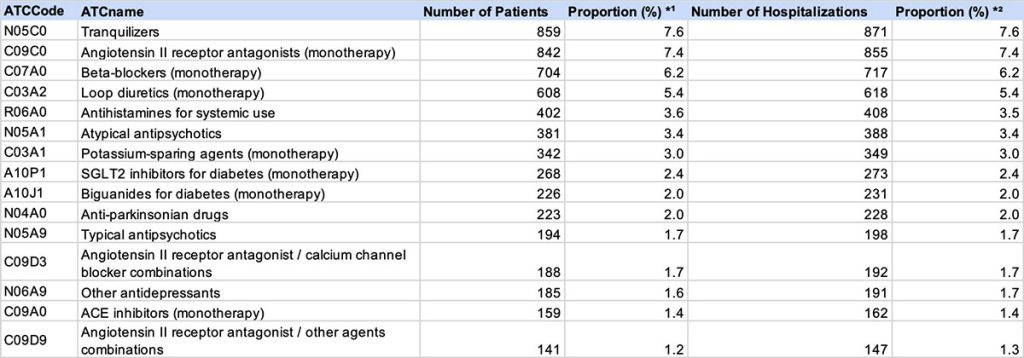
• Target period: April 2022 – May 2025
• Target population: 11,323 patients hospitalized for heatstroke during the target period, corresponding to 11,520 total hospitalizations
*1: Number of patients prescribed the relevant drug during the 100 days prior to the admission date / number of patients hospitalized for heatstroke
*2: Number of patients prescribed the relevant drug during the 100 days prior to the admission date / number of hospitalizations for heatstroke
Trends:
For drugs that have been reported to be associated with the risk of heatstroke onset, we aggregated prescription status during the 100 days prior to hospitalization among patients admitted for heatstroke.
The highest prescription proportion was observed for tranquilizers/sedatives (7.6%), followed by angiotensin II receptor blockers as single agents (7.4%), beta-blockers as single agents (6.2%), and loop diuretics as single agents (5.4%). Other drugs, including antihistamines, antipsychotics, SGLT2 inhibitors, and biguanide antidiabetic agents, were also observed at certain levels.
Interpretation:
This aggregation was conducted specifically for drug classes that have been reported to be associated with the risk of heatstroke onset. The results showed that many patients had been prescribed psychotropic/neuropsychiatric medications, antihypertensive agents, diuretics, and antidiabetic agents.
In particular, psychotropic/neuropsychiatric medications such as tranquilizers/sedatives and antipsychotics are known to affect thermoregulatory and sweating functions, and their association with heatstroke risk has been reported. Cardiovascular drugs such as angiotensin II receptor blockers, beta-blockers, and diuretics were also observed among the most frequently prescribed drugs.
On the other hand, the proportion of each drug class among all patients hospitalized for heatstroke was less than 10%, and no concentration in a single drug class was observed. These findings indicate that patients hospitalized for heatstroke include individuals with diverse clinical backgrounds, including those broadly prescribed medications for chronic conditions such as hypertension, diabetes, and psychiatric or neurological disorders.
2.Trends in Prior Prescriptions among Patients with Heatstroke and AKI
First, we summarized trends in the number of patients with heatstroke and the number of patients with concomitant AKI.

• Target period: April 2022 – December 2024
• Target diseases: Heatstroke (ICD-10: T67), AKI (ICD-10: N17; disease name code: 8849597)
*3: Number of actual patients with heatstroke complicated by AKI / number of actual patients hospitalized for heatstroke in each year
Trend:
The number of patients with heatstroke increased from 3,120 in 2022 to 4,074 in 2023 and 4,459 in 2024. The number of patients with heatstroke complicated by AKI also increased, from 275 to 380 and then to 450 patients. The AKI complication rate increased year by year, from 8.8% to 9.3% and then to 10.1%.
Next, we summarized the prescription status of AKI-related drugs during the 100 days prior to hospitalization among patients with heatstroke complicated by AKI.

• Target period: April 2022 – December 2024
• Target diseases: Heatstroke (ICD-10: T67), AKI (ICD-10: N17; disease name code: 8849597)
• Target drugs: Diuretics (ATC3: C03), RAS inhibitors (ATC3: C09)
*4: Number of patients prescribed the relevant drug during the 100 days prior to the admission date / number of actual patients with heatstroke complicated by AKI
Trend:
Among patients with heatstroke complicated by AKI, the proportion of patients prescribed diuretics within the 100 days prior to hospitalization remained largely stable, at 2.5% in 2022, 2.4% in 2023, and 2.2% in 2024. In contrast, the proportion of patients prescribed RAS inhibitors increased from 3.3% to 6.8%, before reaching 5.8% in 2024. The proportion of patients receiving concomitant diuretics and RAS inhibitors increased to 4.5% in 2023, before declining to 2.2% in 2024.
Interpretation:
Among patients with heatstroke complicated by AKI, the proportion of patients prescribed RAS inhibitors was higher than that of patients prescribed diuretics alone. RAS inhibitors are widely used in patients with chronic conditions such as hypertension, chronic kidney disease, and heart failure. These findings suggest that AKI associated with heatstroke may occur among patients with underlying diseases.
In addition, a certain number of patients were receiving concomitant diuretics and RAS inhibitors, suggesting the inclusion of patient groups who may be more susceptible to changes in body fluid volume and renal hemodynamics. When evaluating the risk of AKI associated with heatstroke, it is considered important to understand patient background, including underlying diseases and medication status, in addition to meteorological factors.
3. Implementation Status of Renal Replacement Therapy in Severe Heatstroke

• Target period: April 2022 – December 2024
• Target disease: AKI (ICD-10: N17; standard disease name code: 8849597)
• Target medical procedures: CRRT (medical procedure code: J042), artificial kidney [other] (medical procedure code: 140007710)
Trend:
The number of patients with heatstroke complicated by AKI increased from 275 in 2022 to 380 in 2023 and 450 in 2024. In comparison, the number of patients who underwent CRRT was 8, 12, and 17, respectively. The number of patients for whom “artificial kidney [other]” was claimed under the medical fee schedule was 4 in both 2022 and 2023, and 14 in 2024.
As a proportion of patients with AKI, the CRRT implementation rate was 2.9%, 3.2%, and 3.8%, respectively. Meanwhile, the claim rate for artificial kidney [other] was 1.5%, 1.1%, and 3.1%, respectively.
Interpretation:
As the number of patients with heatstroke complicated by AKI increased, the number of patients undergoing renal replacement therapy-related procedures also showed an increasing trend. The CRRT implementation rate increased gradually from 2022 to 2024. In addition, the number of patients with claims for artificial kidney [other] increased in 2024, and the claim rate was also higher than in previous years.
Although patients requiring renal replacement therapy represent only a subset of all patients with AKI, opportunities to provide intensive care and renal replacement therapy-related procedures for severe cases appear to be increasing. These results indicate the actual use of medical resources for severe AKI associated with heatstroke. In particular, in 2024, increases were observed both in the number of patients undergoing CRRT and in the number of patients with claims for artificial kidney [other].
Note: This article was published on July 1, 2026.

Data survey and analysis tailored to your specific requests
Databases, data analysis requests, and more.

© Medical Data Vision Co., Ltd. All Rights Reserved.