




Trends in Lymphoma Patient Numbers and Real-World Treatment Patterns by Regimen, with a Focus on Diffuse Large B-Cell Lymphoma (DLBCL)
Diffuse large B-cell lymphoma (DLBCL) is the most common type of non-Hodgkin lymphoma and is an aggressive disease that occurs frequently in elderly patients. For many years, R-CHOP, a chemotherapy regimen for malignant lymphoma, has been considered the standard treatment. However, following the results of the POLARIX trial and other evidence, the Clinical Practice Guidelines for Hematologic Malignancies, Version 3.1 (2024 edition) position polatuzumab vedotin plus R-CHP as one of the standard treatments for patients aged 18 to 80 years with an IPI score of 2 or higher. For relapsed or refractory cases, treatment options such as epcoritamab and CAR-T cell therapy are also expanding. Related developments after the time of preparation of this report, September 2026, are summarized at the end of the report in Section 4, “Future Trends (Reference Information).”
September 15 is World Lymphoma Awareness Day, a period during which disease awareness activities for lymphoma are conducted globally. Accordingly, this report focuses on DLBCL and analyzes trends in patient numbers for DLBCL, follicular lymphoma (FL), and Hodgkin lymphoma (HL), as well as regimen implementation status by treatment line and trends in the use of epcoritamab and CAR-T cell therapy, using MDV analyzer and MDV analyzer for Oncology.
1. Patient Number Analysis: DLBCL, Follicular Lymphoma (FL), and Hodgkin Lymphoma (HL)

Target period: January 2023 – December 2025
Target facilities: 438 facilities meeting the baseline conditions, limited to facilities with complete data
Note: Composition ratios represent the proportion of the combined total of DLBCL, FL, and HL.
Trends:
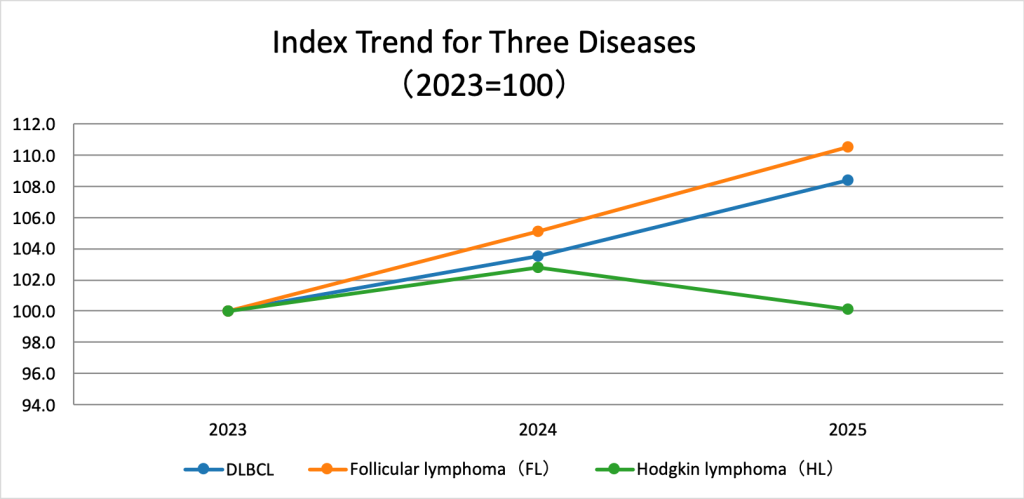
The composition ratios of DLBCL, FL, and HL, as a proportion of the combined total of DLBCL, FL, and HL, were 70.8%, 24.2%, and 5.0% in 2023, respectively. In 2025, the corresponding figures were 70.8%, 24.6%, and 4.6%. Using 2023 as an index value of 100, FL increased to 110.5 and DLBCL increased to 108.4, while HL remained almost unchanged at 100.1.
Interpretation:
DLBCL and FL continued to show an increasing trend, while HL remained largely stable. This confirmed that patient number trends differ by disease type. Regarding age distribution, only HL showed a broader distribution among younger age groups, with a bimodal pattern observed across age strata.
2-1. First-Line Therapy: Composition Ratio by Regimen
- Target period: January 2023 – December 2025
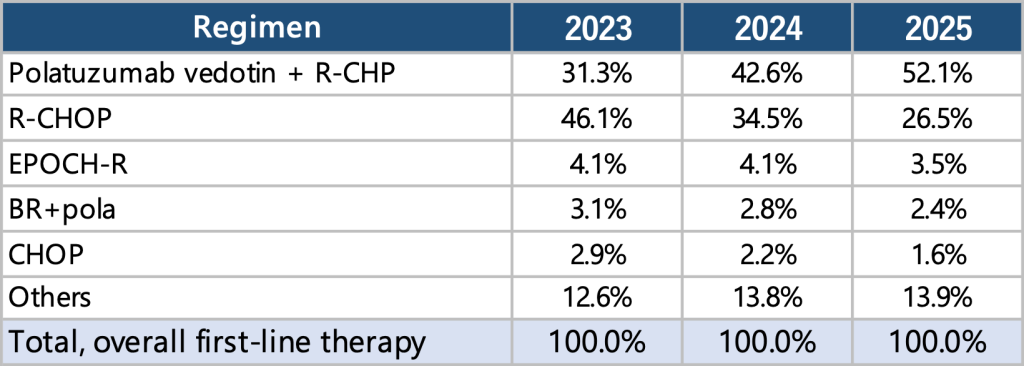
- Target patients: Patients with DLBCL receiving first-line therapy; the number of target patients increased during the study period.
Trends:
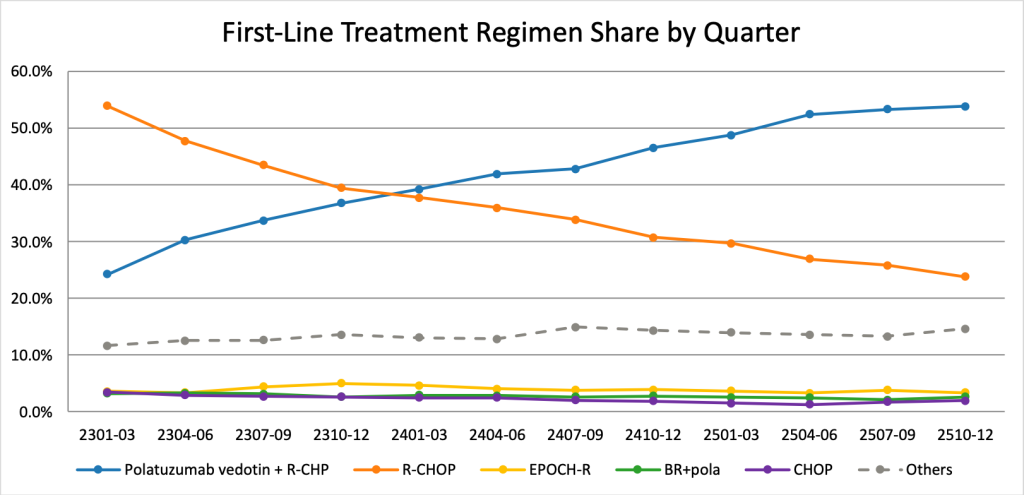
Polatuzumab vedotin + R-CHP increased quarter by quarter, with its composition ratio expanding from 31.3% in 2023 to 52.1% in 2025. In contrast, R-CHOP decreased from 46.1% to 26.5%, and the composition ratios of the two regimens reversed around 2024. The next-ranked regimens, EPOCH-R, BR+pola, and CHOP, were all used on a smaller scale and showed gradual decreases. The “Other” category increased slightly, from 12.6% to 13.9%.
Interpretation:
Against the background of the POLARIX trial results and other factors, a shift in standard treatment from R-CHOP to polatuzumab vedotin + R-CHP has become evident, suggesting that the transition in first-line therapy is progressing in real-world clinical practice.
As of the Clinical Practice Guidelines for Hematologic Malignancies, Version 3.1 (2024 edition), polatuzumab vedotin + R-CHP had already been positioned as one of the standard treatments for patients with an IPI score of 2 or higher. The reversal in composition ratios shown by this data can be interpreted as reflecting the gradual establishment of this guideline positioning in real-world clinical practice. Regimens other than the top five remained in the low-teens as a combined composition ratio, indicating that first-line treatment selection is increasingly concentrated in the top two regimens.
2-2. Second-Line Therapy: Composition Ratio by Regimen
- Target period: January 2023 – December 2025
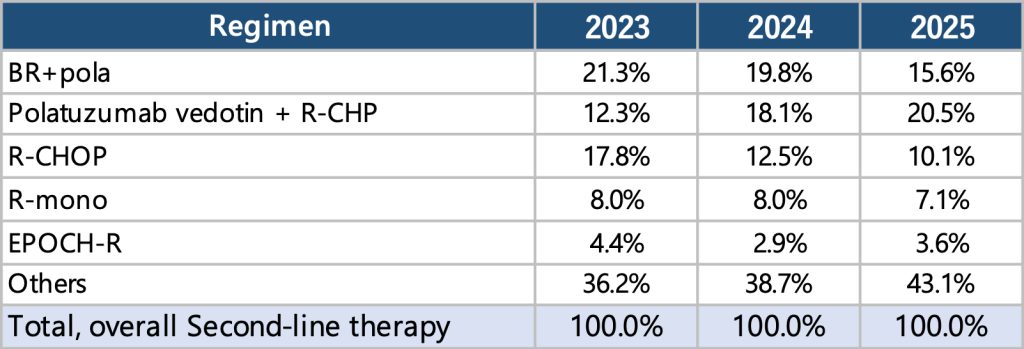
- Target patients: Patients with DLBCL receiving second-line therapy; the number of target patients remained generally stable during the study period.
Trends:
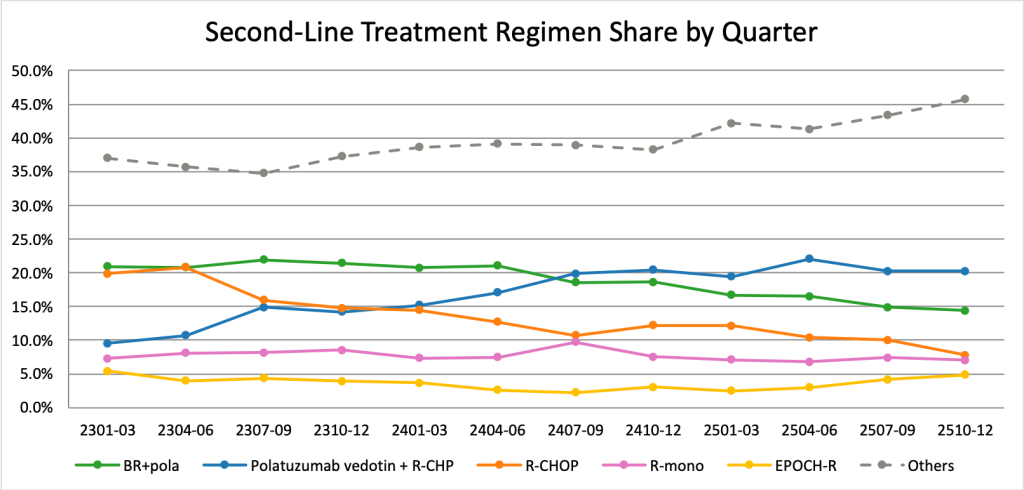
From 2023 to 2025, polatuzumab vedotin + R-CHP increased from 12.3% to 20.5%. In contrast, BR+pola decreased from 21.3% to 15.6%, and R-CHOP decreased from 17.8% to 10.1%. R-mono and EPOCH-R remained relatively stable, although they were used on a small scale. The “Other” category increased from 36.2% to 43.1%, representing the largest composition ratio when combining diverse regimens other than the top five. Over the three-year period, the total scale of prescriptions implemented in second-line therapy corresponded to approximately 28.2% of the three-year total for first-line therapy.
Interpretation:
In second-line therapy, polatuzumab vedotin + R-CHP became the largest regimen by composition ratio, at 20.5%. Although polatuzumab vedotin + R-CHP is generally used in first-line therapy, the reasons it was aggregated as second-line therapy can broadly be grouped into two patterns: first, cases in which the preceding treatment was also the same polatuzumab vedotin + R-CHP regimen and was considered a line change due to factors such as a treatment interruption period; and second, cases in which polatuzumab vedotin appears to have been added to a preceding regimen such as R-CHOP or R-mono, leading to classification as a line change. Cases not corresponding to these patterns were limited.
The trend in BR+pola, one of the representative treatment options for relapsed or refractory DLBCL, decreasing from 21.3% to 15.6%, may also be considered a reference indicator. In addition, this comparison represents the ratio of cumulative patient counts across treatment lines, not the treatment transition rate of the same patients, and therefore does not indicate patient-level treatment transition patterns. Developments related to new approvals and other relevant matters are summarized at the end of this report in Section 4, “Future Trends (Reference Information).”
2-3. Third-Line Therapy: Composition Ratio by Regimen
- Target period: January 2023 – December 2025
- Target patients: Patients with DLBCL receiving third-line therapy; the number of target patients increased during the study period.
Trends:
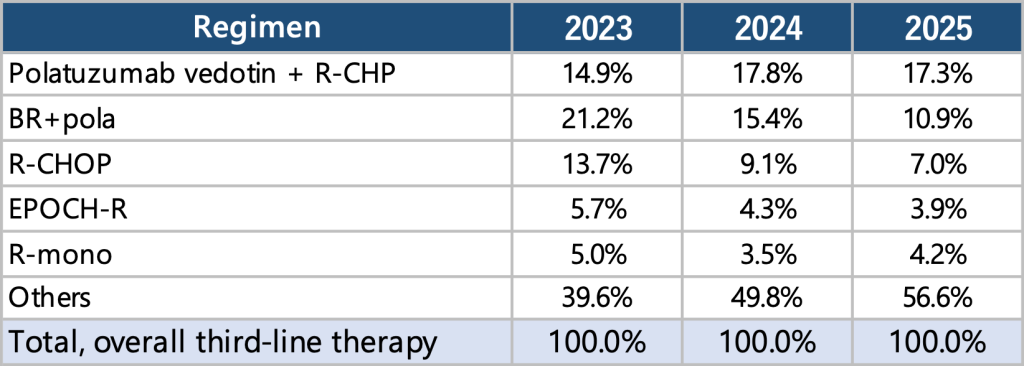
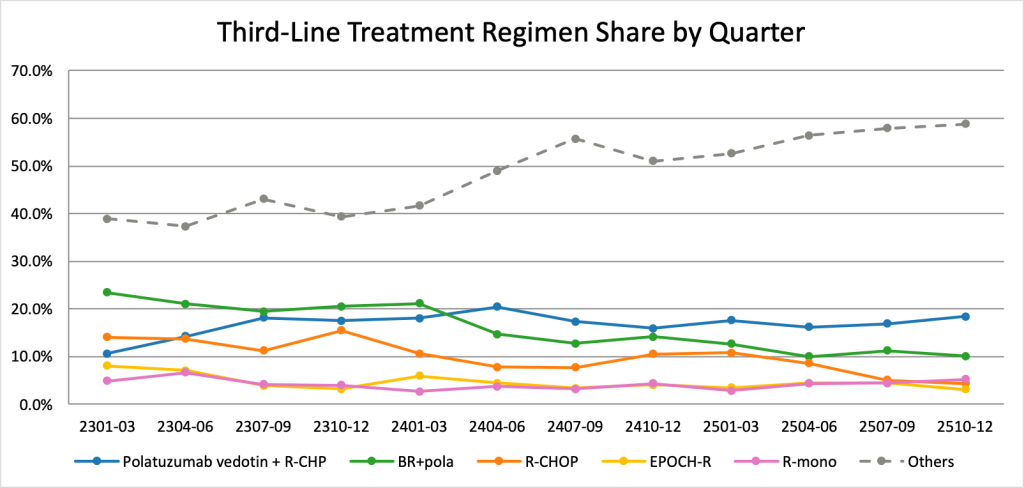
From 2023 to 2025, polatuzumab vedotin + R-CHP increased from 14.9% to 17.3%. In contrast, BR+pola decreased from 21.2% to 10.9%, and R-CHOP decreased from 13.7% to 7.0%. EPOCH-R and R-mono remained stable on a small scale. Overall third-line therapy corresponded to approximately 55.9% of the prescription implementation scale observed in second-line therapy.
Interpretation:
In third-line therapy as well, polatuzumab vedotin + R-CHP was the largest regimen by composition ratio, at 17.3%. As in Section 2-2, the regimen composition ratio of polatuzumab vedotin + R-CHP in later treatment lines should be interpreted as a reference value.
The regimen continuation patterns identified in Section 2-2—namely, cases in which the preceding treatment was also the same polatuzumab vedotin + R-CHP regimen, and cases in which polatuzumab vedotin was added to a preceding regimen such as R-CHOP or R-mono—were similarly observed in third-line therapy.
The trend in BR+pola, decreasing from 21.2% to 10.9%, may also serve as a reference indicator as one representative treatment option for relapsed or refractory DLBCL. In addition, the composition ratio of “Other” increased in later treatment lines, from 39.6% to 56.6%, suggesting that diverse regimens are being selected in real-world practice. The prescription implementation scale was approximately 28.2% for second-line therapy relative to first-line therapy, and approximately 55.9% for third-line therapy relative to second-line therapy. As in Section 2-2, this comparison does not indicate patient-level treatment transition patterns.
3-1. Epcoritamab: Trends in Use Rate
- Target period: January 2023 – December 2025
- Target facilities: 438 facilities meeting the baseline conditions, limited to facilities with complete data
Trends:
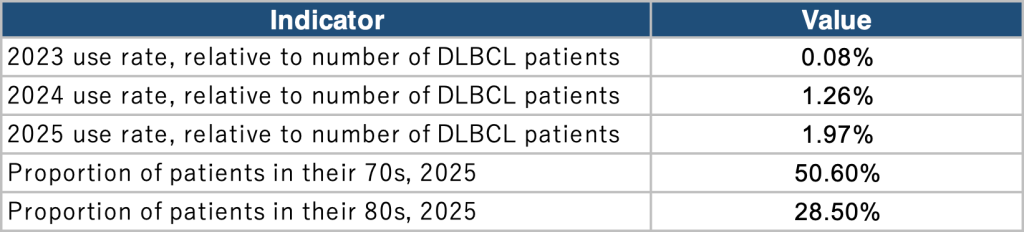
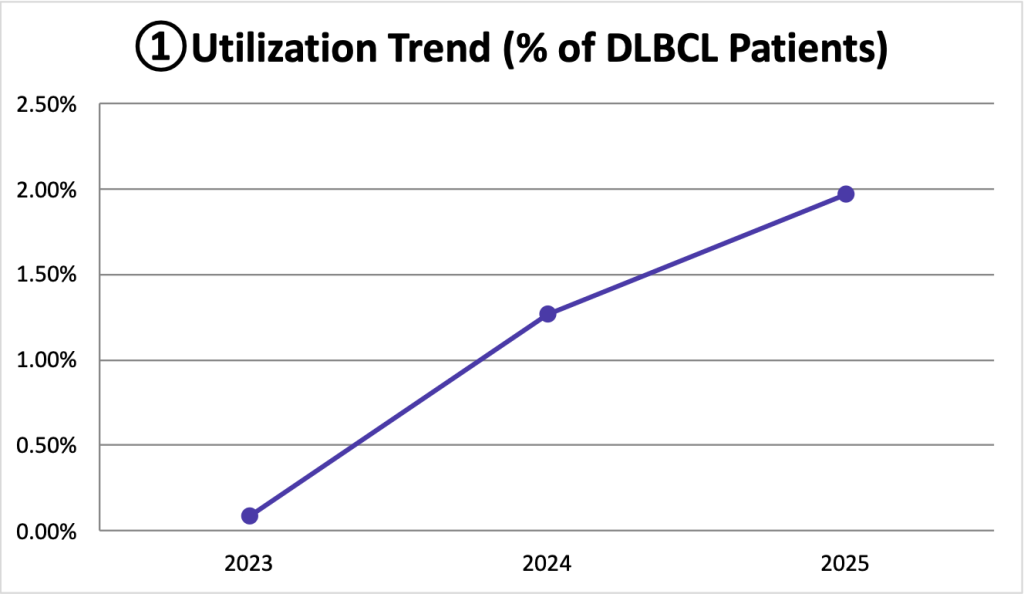
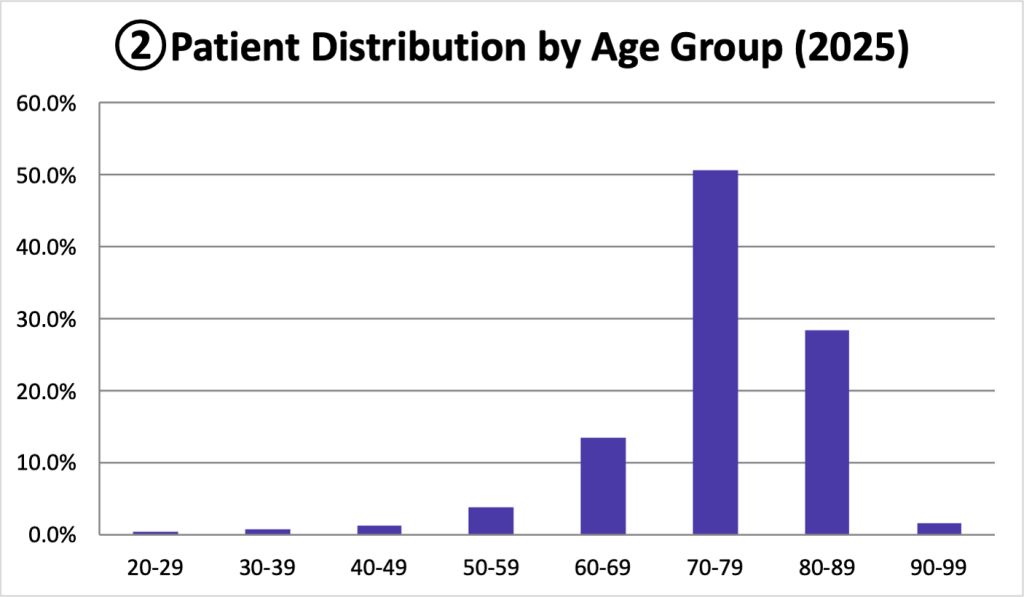
The use rate of epcoritamab, relative to the number of DLBCL patients, rose rapidly from 0.08% in 2023 to 1.26% in 2024 and 1.97% in 2025. By age group in 2025, patients in their 70s accounted for 50.60%, while those in their 80s accounted for 28.50%, meaning that these two age groups together represented approximately 80% of users.
Interpretation:
Epcoritamab has been confirmed to have rapidly spread since 2024 as a new treatment option for relapsed or refractory DLBCL. Its age distribution is centered on patients in their 70s and 80s, which is consistent with the real-world situation in which relapsed or refractory cases with multiple prior treatment histories are common among older patients.
3-2. Comparison with CAR-T Cell Therapy

Trends
The proportion of patients receiving CAR-T cell therapy, relative to the number of DLBCL patients, was 0.19% in 2023, 0.30% in 2024, and 0.51% in 2025. Although a gradual increase was observed, the scale of use remained limited compared with epcoritamab, which reached 1.97% in 2025.
Interpretation
CAR-T cell therapy can be provided only at specific certified facilities and involves a high treatment intensity, including the need for lymphodepleting chemotherapy prior to administration. In contrast, approximately 80% of patients using epcoritamab were in their 70s and 80s, as shown in Section 3-1. Differences in eligible patient backgrounds and facility requirements between the two treatment modalities may have influenced the difference in scale of use.
4. Future Trends — Reference Information
The analysis period of this report is January 2023 to December 2025. However, the following related developments have been confirmed in 2026.
First, in March 2026, combination therapy with mosunetuzumab plus polatuzumab vedotin was newly approved for relapsed or refractory large B-cell lymphoma in patients who are ineligible for autologous hematopoietic stem cell transplantation.
Second, in April 2026, the Japanese Society of Hematology issued a notice regarding points to consider for DPC reimbursement calculation when this combination therapy is used in the inpatient setting. This indicates that the complexity surrounding DPC reimbursement calculation and line determination for polatuzumab-containing regimens has also been recognized by the academic society.
Third, the next revised edition of the Clinical Practice Guidelines for Hematologic Malignancies, Version 4.0 (2026 edition) is scheduled for publication in October 2026 and had not yet been published at the time of writing this report in September 2026.
These developments may affect future real-world treatment patterns in DLBCL and the interpretation of DPC data. They should therefore continue to be monitored.
Note: This article was published on September 1 , 2026.

Data survey and analysis tailored to your specific requests
Databases, data analysis requests, and more.

© Medical Data Vision Co., Ltd. All Rights Reserved.