




Patient Dynamics in Endocrine and Metabolic Diseases and Longitudinal Trends in Pre-Diagnostic Laboratory Values
Endocrine and metabolic diseases are therapeutic areas characterized by hormone secretion abnormalities and metabolic dysfunctions that require long-term disease management. In recent years, the importance of individualized treatment approaches that consider the risk of complications has increased, supported by the introduction of therapies with cardiovascular and renal protective effects. In June 2026, the Annual Meeting of the Japan Endocrine Society and the International Congress of Endocrinology (ICE2026) are scheduled to be jointly held in Japan, likely increasing domestic and international interest in this therapeutic area.
In conjunction with this period of heightened international attention, this report uses MDV’s DPC data and MDV analyzer for Clinical Insight to analyze trends in patient numbers in endocrine and metabolic diseases in Japan, as well as average longitudinal trends in key laboratory values during the 180 days prior to diagnosis.
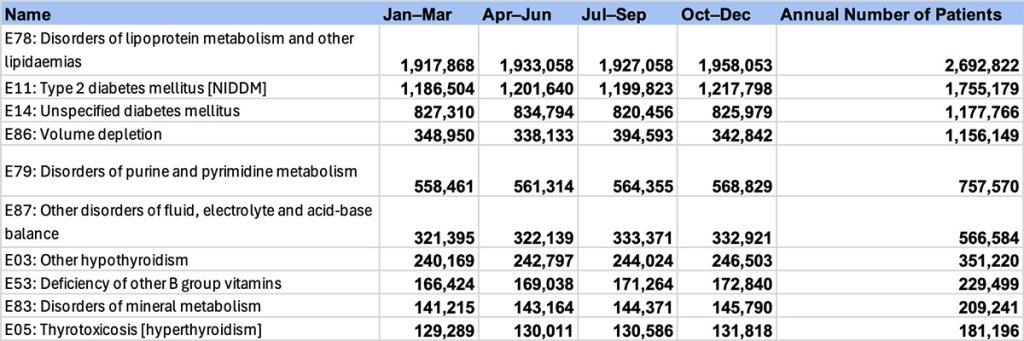
1. Trends in the Top 10 Endocrine and Metabolic Diseases by Actual Patient Numbers (January–December 2025)
• Data period: January 2025 – December 2025
• Target hospitals: Hospitals for which all data for the specified period were available
Data Trends:
In quarterly data for 2025, “Disorders of lipoprotein metabolism and other lipidemias (E78)” had the highest annual number of actual patients at 2,692,822, remaining relatively stable at approximately 1.91–1.95 million patients per quarter.
This was followed by “Type 2 diabetes mellitus (E11)”, with an annual patient count of 1,755,179 (approximately 1.18–1.21 million patients per quarter), and “Unspecified diabetes mellitus (E14)”, with 1,177,766 annual patients.
Overall, no substantial seasonal fluctuations were observed.
Interpretation:
Common chronic diseases with high prevalence, such as dyslipidemia and type 2 diabetes mellitus, ranked highest and demonstrated stable healthcare utilization patterns throughout the year.
The continued presence of a substantial number of patients categorized as “unspecified diabetes mellitus” may reflect cases registered prior to definitive subtype classification during the early diagnostic phase, as well as cases in which disease subtype classification remains unresolved. These findings further highlight the importance of disease awareness and diagnostic support aimed at appropriate subtype classification and treatment optimization in real-world clinical practice.
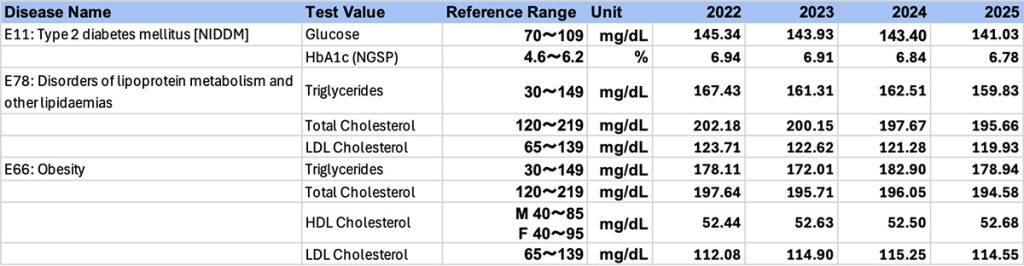
2.Longitudinal Trends in Pre-Diagnostic Laboratory Values for Major Metabolic Diseases (2022–2025)
For major metabolic diseases, average laboratory values during the 180 days prior to diagnosis were extracted for key laboratory parameters.
• Data period: January 2022 – December 2025
• Target hospitals: Hospitals for which data for the specified years were available
Data Trend:
From 2022 to 2025, HbA1c (NGSP) in patients with type 2 diabetes mellitus (E11) declined from 6.94% to 6.78%, while glucose levels decreased from 145.34 mg/dL to 141.03 mg/dL. For disorders of lipoprotein metabolism and other lipidemias (E78), total cholesterol decreased from 202.18 mg/dL to 195.66 mg/dL, while LDL cholesterol declined from 123.71 mg/dL to 119.93 mg/dL.
Interpretation:
Major metabolic indicators demonstrated an overall trend toward improvement in average laboratory values during the 180-day period prior to diagnosis.
These findings may suggest that, alongside expanded health checkup and screening opportunities and increased disease awareness, a greater proportion of patients are being diagnosed at earlier and potentially less severe stages than previously observed.
In addition, within the fields of diabetes and dyslipidemia, increased recognition of the importance of early intervention aimed at preventing cardiovascular and renal events may have contributed to earlier timing of detailed examinations and clinical follow-up in healthcare settings.
Going forward, the importance of providing information to support appropriate treatment selection and improved long-term outcomes among patients diagnosed at earlier stages is expected to continue increasing.
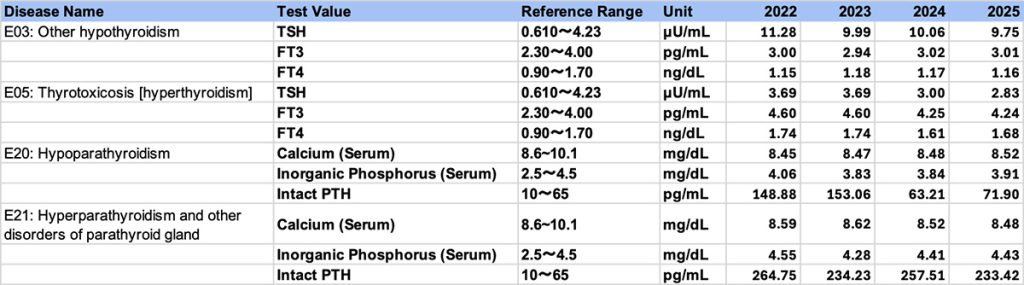
3. Longitudinal Trends in Pre-Diagnostic Laboratory Values for Major Thyroid and Parathyroid Disorders (2022–2025)
For thyroid and parathyroid disorders, average laboratory values during the 180 days prior to diagnosis were extracted for key laboratory parameters.
• Data period: January 2022 – December 2025
• Target hospitals: Hospitals for which data for the specified years were available
Data Trend:
From 2022 to 2025, TSH levels in thyrotoxicosis (E05) declined from 3.69 μU/mL to 2.83 μU/mL, while FT3 and FT4 also demonstrated declining trends over time.
For hyperparathyroidism and other disorders of the parathyroid gland (E21), calcium levels slightly decreased from 8.59 mg/dL to 8.48 mg/dL, while inorganic phosphorus decreased from 4.55 mg/dL to 4.43 mg/dL. Intact PTH fluctuated year to year but showed an overall decline from 264.75 pg/mL to 233.42 pg/mL.
Interpretation:
At an early stage—specifically, 180 days prior to confirmed diagnosis—year-over-year changes in hormone-related laboratory indicators were observed for certain diseases.
These changes may reflect expanded disease awareness and broader screening opportunities in clinical practice.
Additionally, increased implementation of early laboratory testing triggered by non-specific symptoms (e.g., fatigue or muscle weakness), as well as incidental identification of latent thyroid or parathyroid dysfunction during diagnostic workups for unrelated conditions, may also contribute to these trends.
Looking ahead, from the perspectives of appropriate intervention at milder disease stages and prevention of long-term complications, the importance of providing information to support treatment optimization following early diagnosis is expected to increase further.
Note: This article was published on June 1, 2026.

Data survey and analysis tailored to your specific requests
Databases, data analysis requests, and more.

© Medical Data Vision Co., Ltd. All Rights Reserved.