



Trends in the Number of Patients with Psoriasis and Prescribing Patterns by Drug Class : Focus on the Growth of TYK2 Inhibitors and JAK1 Inhibitors as Oral Treatment Options Following Biologics
Psoriasis is an immune-mediated disease characterized by chronic inflammation of the skin, resulting in erythematous plaques accompanied by thick scales. While psoriasis vulgaris accounts for the majority of cases, several clinical subtypes exist, including palmoplantar pustulosis, which causes pustules on the palms and soles; psoriatic arthritis, in which inflammation extends to the joints; and severe forms accompanied by generalized pustulosis or erythroderma. Although the prevalence of psoriasis in Japan is considered lower than in Western countries, the degree of quality-of-life (QOL) impairment has been reported to be comparable to that associated with cancer and diabetes. Treatment generally follows a stepwise approach, beginning with topical therapy and escalating to phototherapy, systemic oral therapy, and biologic agents as needed.
In recent years, in addition to the expanding range of biologic therapies, new oral systemic treatment options have emerged, including TYK2 inhibitors indicated for psoriatic arthritis and cutaneous forms of psoriasis and JAK1 inhibitors indicated for psoriatic arthritis. At the same time, treatment goals for skin symptoms have been shifting toward achieving PASI 90/100*¹ and DLQI remission*².
October 29 is World Psoriasis Day, established by the International Federation of Psoriasis Associations (IFPA), a time when awareness activities related to psoriasis are conducted worldwide. In recognition of this occasion, we analyzed trends in the number of psoriasis patients and prescribing patterns by drug class using MDV Analyzer.
*¹ PASI (Psoriasis Area and Severity Index): An assessment measure that quantifies the extent and severity of skin lesions. PASI 90/100 indicates a 90% or 100% improvement from baseline.
*² DLQI (Dermatology Life Quality Index): An assessment measure that evaluates the impact of skin disease on a patient’s quality of life. Remission is defined as a score of 0-1.
1. Patient Analysis: Distribution by Major Clinical Subtype
- Analysis period: January 2023 to December 2025
- Included facilities: Facilities within the MDV database with complete data available throughout the analysis period
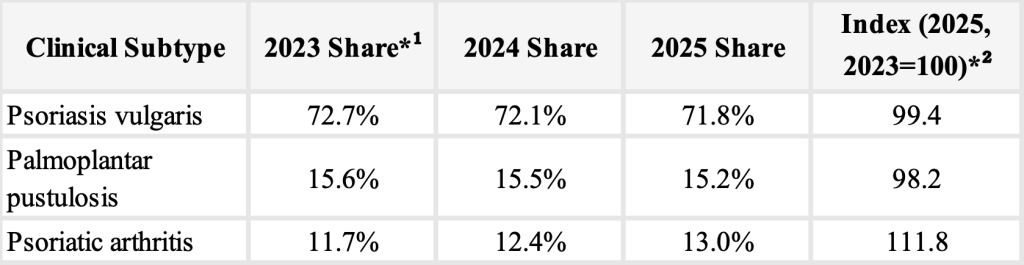
*¹ Share represents the proportion of each subtype among the total of psoriasis vulgaris, palmoplantar pustulosis, and psoriatic arthritis.
*² The index (2025, 2023=100) represents the index of actual patient counts (non-unique aggregated patients), not the index of the composition ratios shown in the table.
Trends:
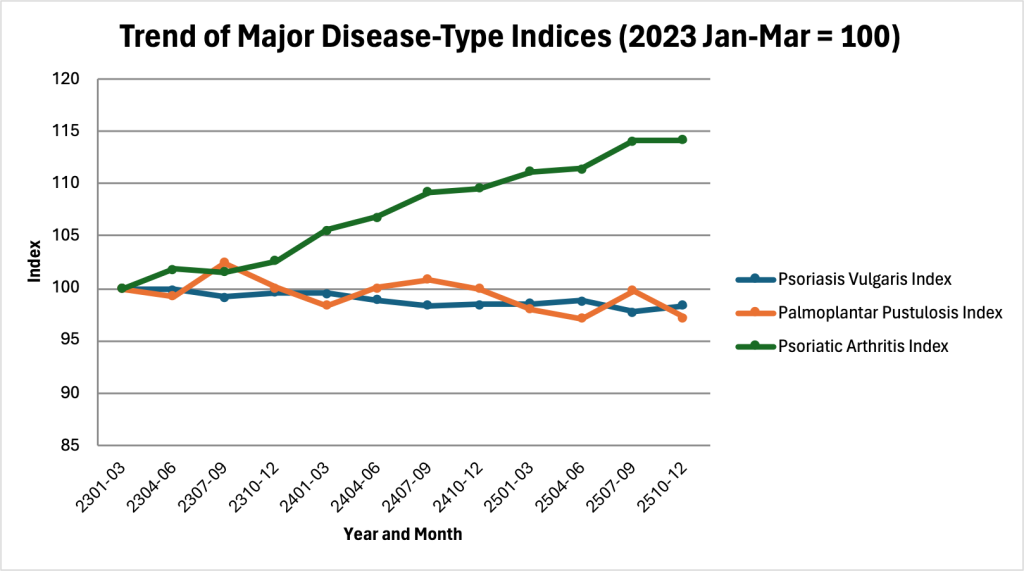
The proportions of psoriasis vulgaris, palmoplantar pustulosis, and psoriatic arthritis were 72.7%, 15.6%, and 11.7%, respectively, in 2023, compared with 71.8%, 15.2%, and 13.0% in 2025. Using 2023 as the baseline (100), the annual patient index for psoriatic arthritis increased to 111.8, while psoriasis vulgaris and palmoplantar pustulosis remained largely stable at 99.4 and 98.2, respectively.
Quarterly indices based on 1Q 2023 (=100) showed a similar pattern, with psoriatic arthritis increasing overall to 114.2, contrasting with the relatively stable trends observed for the other two subtypes (98.4 and 97.2).
Interpretation:
While the numbers of patients with psoriasis vulgaris and palmoplantar pustulosis remained generally stable, psoriatic arthritis showed a continuing upward trend. These findings may reflect the increasing importance of identifying and evaluating patients who present with both skin and joint manifestations in clinical practice.
2-1. Prescription Share by Drug Class: All Patients
- Analysis period: January 2023 to December 2025
- Patient population: Patients diagnosed with psoriasis (ICD-10 code L40) who received a prescription for at least one of the target drug classes (non-unique aggregated patients; annual total of monthly patient counts).
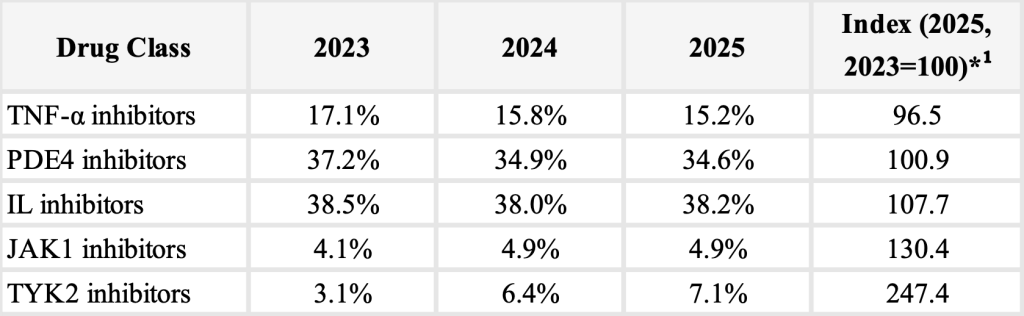
*¹ The index (2025, 2023=100) represents actual patient counts rather than the composition ratios shown in the table.
Trends:
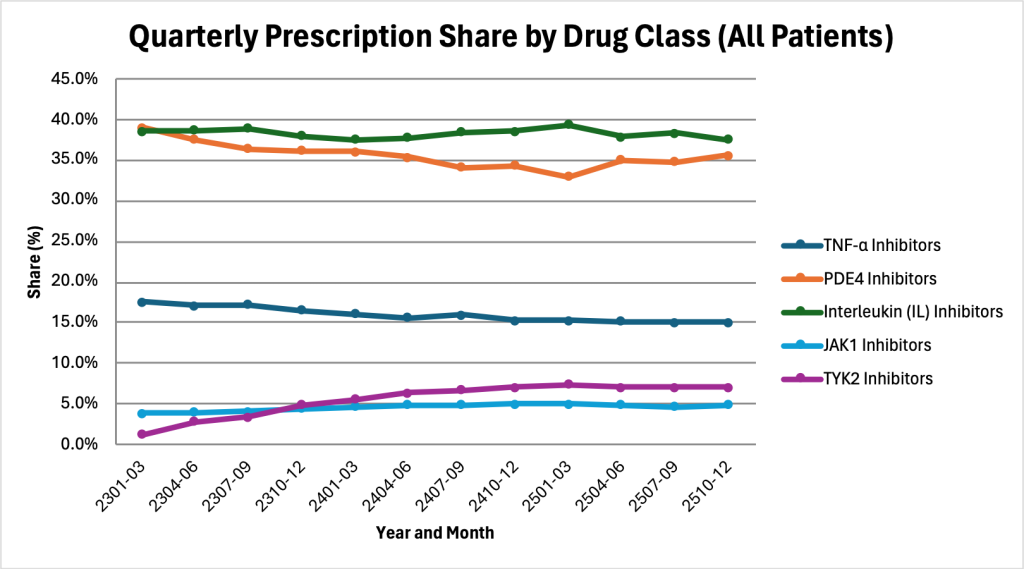
IL inhibitors and PDE4 inhibitors continued to account for more than 70% of prescriptions combined, remaining the two largest treatment categories. Meanwhile, the share of TYK2 inhibitors increased from 3.1% in 2023 to 7.1% in 2025, and JAK1 inhibitors increased from 4.1% to 4.9%.
Using 2023 as the baseline (100), the patient index reached 247.4 for TYK2 inhibitors and 130.4 for JAK1 inhibitors, highlighting significant growth among these two oral treatment categories. In contrast, the index for TNF-α inhibitors declined slightly to 96.5.
Interpretation:
Although biologics continue to represent the core of psoriasis treatment, JAK1 inhibitors and TYK2 inhibitors have expanded their share among oral systemic treatment options (PDE4 inhibitors, JAK1 inhibitors, and TYK2 inhibitors). These findings may suggest an increasing preference in routine clinical practice for oral treatment options that reduce the burden associated with clinic visits and self-injection.
2-2. Prescription Share by Drug Class: Newly Initiated Patients (No Prior Treatment for 180 Days)
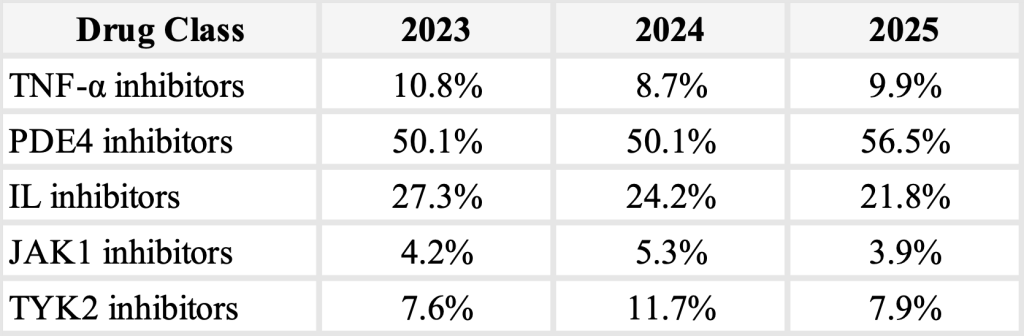
- Analysis period: January 2023 to December 2025
- Patient population: Patients who initiated treatment after having no prescription for any target drug during the preceding 180 days (non-unique newly initiated patients)
*¹ The index (2025, 2023=100) represents actual patient counts rather than the composition ratios shown in the table.
Trends:
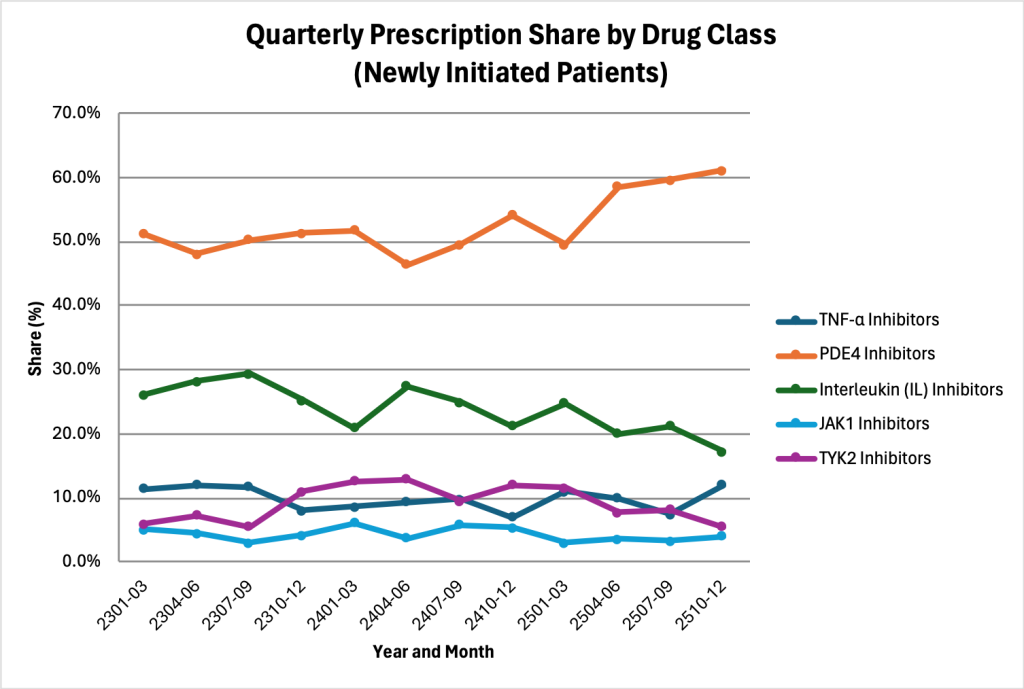
Among newly initiated patients, PDE4 inhibitors consistently accounted for more than half of prescriptions, increasing from 50.1% in 2023 to 56.5% in 2025. In contrast, IL inhibitors declined from 27.3% to 21.8% over the same period. TYK2 inhibitors increased to 11.7% in 2024 before declining slightly to 7.9% in 2025.
Interpretation:
Among patients starting new treatment, PDE4 inhibitors and IL inhibitors remained the two leading treatment categories. At the same time, TNF-α inhibitors, JAK1 inhibitors, and TYK2 inhibitors showed quarter-to-quarter fluctuations. The Prescription Share initiated on TYK2 inhibitors increased in 2024 but declined in 2025, suggesting a reaction following an initial period of expansion in new treatment adoption.
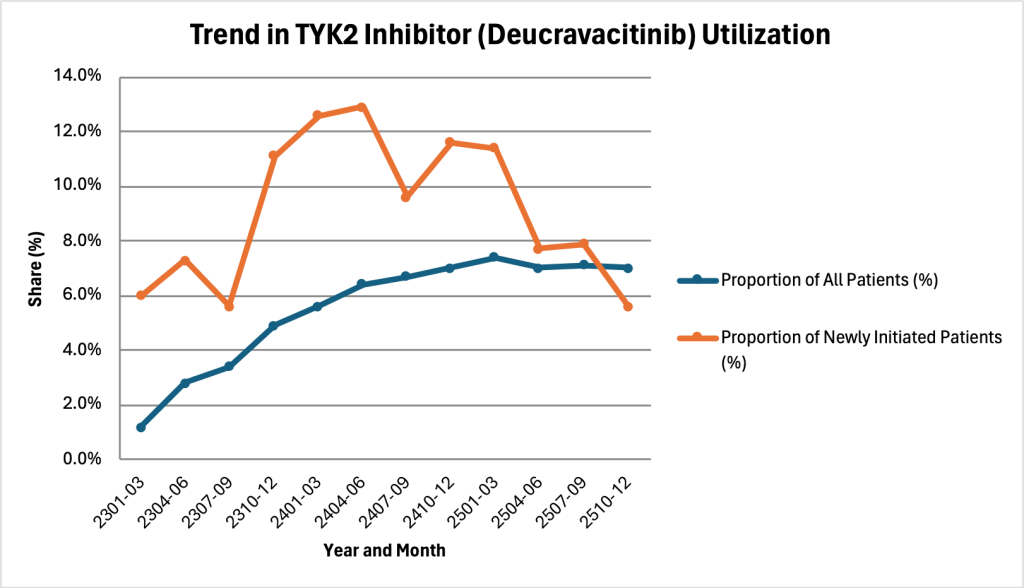
3. Utilization Trends of the TYK2 Inhibitor Deucravacitinib

- Analysis period: January 2023 to December 2025
- Patient population: Patients with psoriasis who received a prescription for deucravacitinib.
*¹ The index (2025, 2023=100) represents actual patient counts rather than the composition ratios shown in the table.
Trends:
Deucravacitinib, launched in November 2022, increased its share among all treated patients from 3.1% in 2023 to 7.1% in 2025. On a quarterly basis, its share rose steadily from 1.2% in 1Q 2023 and remained at around 7% during the second half of 2025.
Among newly initiated patients, the share of deucravacitinib increased to 11.7% in 2024 before declining to 7.9% in 2025. The total number of newly initiated patients also peaked in 2024 and decreased in 2025.
Interpretation:
As the world’s first oral TYK2 inhibitor, deucravacitinib is becoming established as one of the oral treatment options for patients with an inadequate response to existing therapies. However, the number of newly initiated patients peaked in 2024 and declined in 2025, indicating a slowing pace of new adoption. At the same time, its share among all treated patients remained at approximately 7% in 2025. Continued monitoring of both absolute patient numbers and market share will be important going forward.
Note: This article was published on October 2 , 2026.

Data survey and analysis tailored to your specific requests
Databases, data analysis requests, and more.

© Medical Data Vision Co., Ltd. All Rights Reserved.