



A Guide to Pharmacoepidemiology in Japan: Using Data to Understand Real-World Medication Use, Safety, and Outcomes
Post-marketing database studies accounted for 18.9% of all planned post-marketing surveillance activities in Japan in 2024, a marked rise on earlier years. Pharmacoepidemiology has become an established component of post-marketing safety and lifecycle evidence generation in Japan, and for global sponsors it is one of the main routes through which long-term questions are now addressed.
The subject matter is straightforward even where the methods are not. Pharmacoepidemiology asks how medicines are actually used once they leave the trial setting, and how they perform in patients who would never have been enrolled. This article covers why Japan is unusually well suited to that work, which datasets support it, which study designs are accepted, where the discipline sits within the country’s post-marketing rules, and where projects most often run into trouble.
Why Japan is well suited to real-world medication research
Japan is the world’s third-largest pharmaceutical market, valued at approximately USD 87 billion in 2025, and its healthcare system provides universal insurance coverage, and the claims it generates describe most insured care nationwide. That gives an unusually continuous account of prescribing and utilisation, although self-funded treatment, occupational injury schemes, and normal childbirth fall outside it.
Demographics make the record unusually informative. Around 29% of the population is aged 65 or over, so concurrent therapy, long exposure, and accumulated comorbidity are ordinary rather than exceptional. These groups are often underrepresented in trials, yet they are where interactions and cumulative risk become visible.
Duration matters as much as breadth. Chronic disease management in Japan often runs for years or decades, well beyond the follow-up any registration programme can fund. Where a registration trial describes a treatment over months, Japanese real-world data can often follow it for considerably longer, subject to how far back the database extends and whether patients remain within its coverage. Questions about cumulative exposure, late-emerging risk, and long-term persistence become tractable at that timescale.
What pharmacoepidemiology contributes in practice
The discipline sits between epidemiology, clinical medicine, and regulatory evidence, and its value in Japan is mostly practical. Trials establish what a medicine can do under controlled conditions. Pharmacoepidemiology establishes what happens when the same medicine is used amid routine prescribing, imperfect adherence, and several concurrent conditions. Both are necessary, and neither substitutes for the other.
That gap is where most post-approval questions live. Real-world studies can show whether adherence and persistence differ by patient group, whether outcomes hold in older or more comorbid populations, and how much variation exists between hospitals and regions. Each of those findings changes how a product is positioned, monitored, or explained to clinicians. A therapy that performs well in trial conditions but is discontinued early in practice presents a different commercial and clinical problem from one that simply underperforms.
The same evidence supports decisions beyond safety. Long-term monitoring, evaluation of rare adverse events, formal post-marketing surveillance commitments, and health economic analysis all draw on the same underlying data. Because Japanese evidence expectations differ from other markets, local relevance and dataset feasibility deserve assessment before a programme is designed rather than after. Retrofitting a global protocol to Japanese data is consistently more expensive than planning for it at the outset.
The datasets behind Japanese pharmacoepidemiology
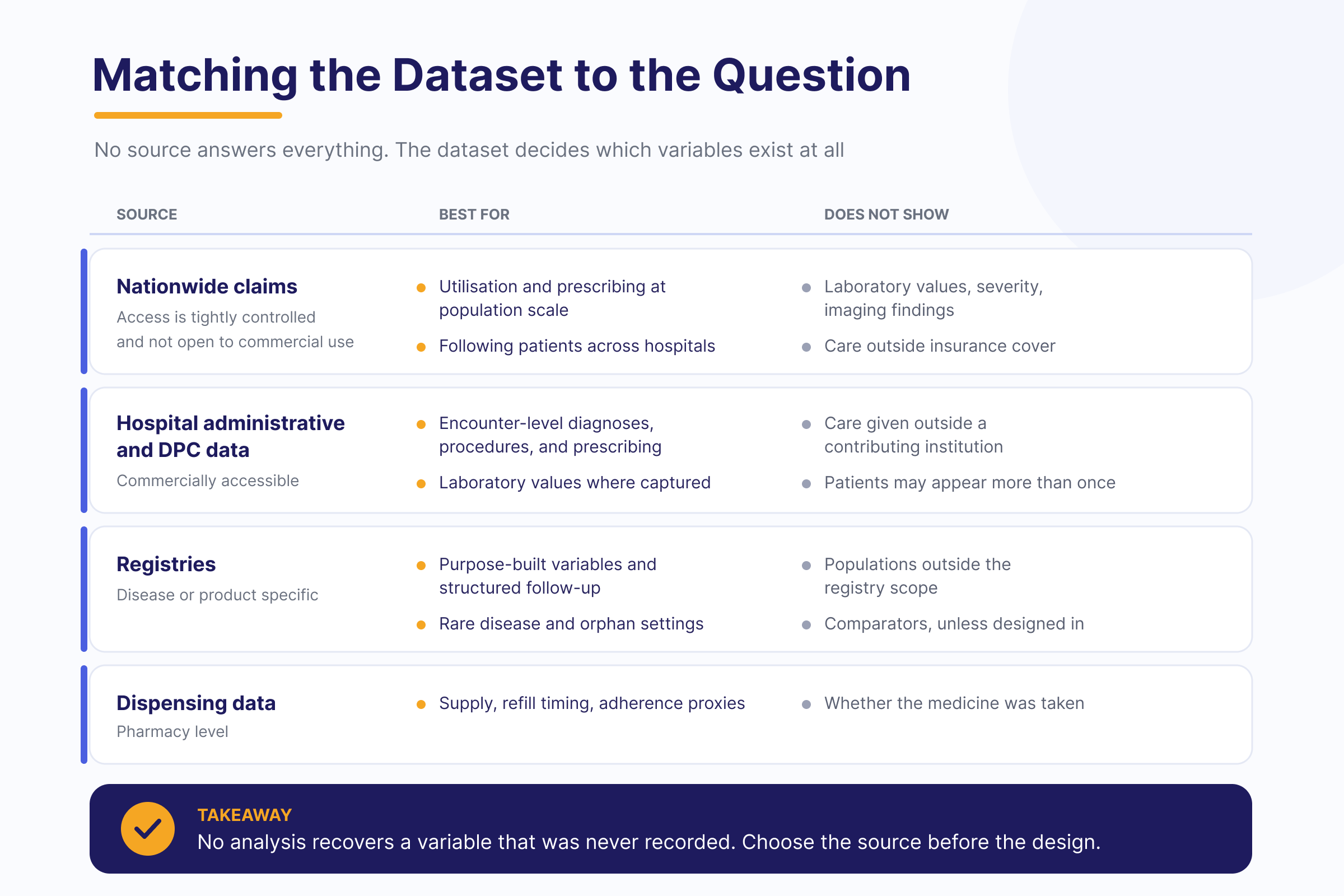
Japan offers several sources, and each answers a different kind of medication question. Choosing between them is the single decision that most affects what a study can conclude, because the dataset determines which exposures, outcomes, and confounders are measurable. No amount of analytical sophistication recovers a variable that was never recorded.
National claims data
The National Database of Health Insurance Claims and Specific Health Checkups covers most insured care nationwide and supports analysis of treatment initiation and switching, concomitant medication, persistence proxies, and safety monitoring at population scale. Access is tightly controlled and granted against public interest criteria, so it is not generally available for commercial research, and sponsors more often work with commercially accessible claims and hospital databases.
Claims were built for reimbursement, and that shows in what they omit. Laboratory values, disease severity, and imaging findings are largely absent, and diagnosis codes carry administrative billing logic instead of definitive clinical diagnoses. Studies that depend on clinical measures usually need a second source alongside it. A common pattern is to size the population in claims data first, then move to hospital records for the clinical detail that determines the endpoint.
Hospital administrative and DPC-based data
Hospital datasets add detail that nationwide claims cannot carry. Japan’s DPC system, adopted by over 1,700 acute care hospitals, applies a common structure to discharge and claims records, which reduces, though does not eliminate, the harmonisation work needed to combine data across institutions. Laboratory values are available for the institutions and periods where hospital systems capture them.
Scale and consistent structure together are what make these sources usable for medication research. MDV’s hospital database draws on administrative and DPC records for approximately 60 million patients from more than 850 hospitals. Okami and colleagues reported in Clinical and Translational Science in 2026 that it was the most frequently used data source among the post-marketing database studies they identified. Because coverage is hospital-based, care given outside a contributing institution is not captured, and a patient treated at several hospitals may appear more than once.
Registries, public statistics, and dispensing data
Registries provide structured longitudinal follow-up in defined cohorts, with stronger clinical characterisation than claims sources, and they remain the natural choice for natural history work and long-term outcomes in oncology and rare disease. Access and structure vary widely between registries, so feasibility deserves an early check rather than an assumption. Two registries in the same therapeutic area can differ enough in governance and variable capture that one supports a study and the other does not.
National statistics and surveys rarely support patient-level analysis on their own, but they frame disease burden and system utilisation in a way that strengthens study rationale. Pharmacy dispensing data, where available, clarifies fill patterns, persistence, and medication gaps, which makes it particularly useful for adherence questions even when linkage to clinical outcomes is limited.
Study designs accepted in Japan
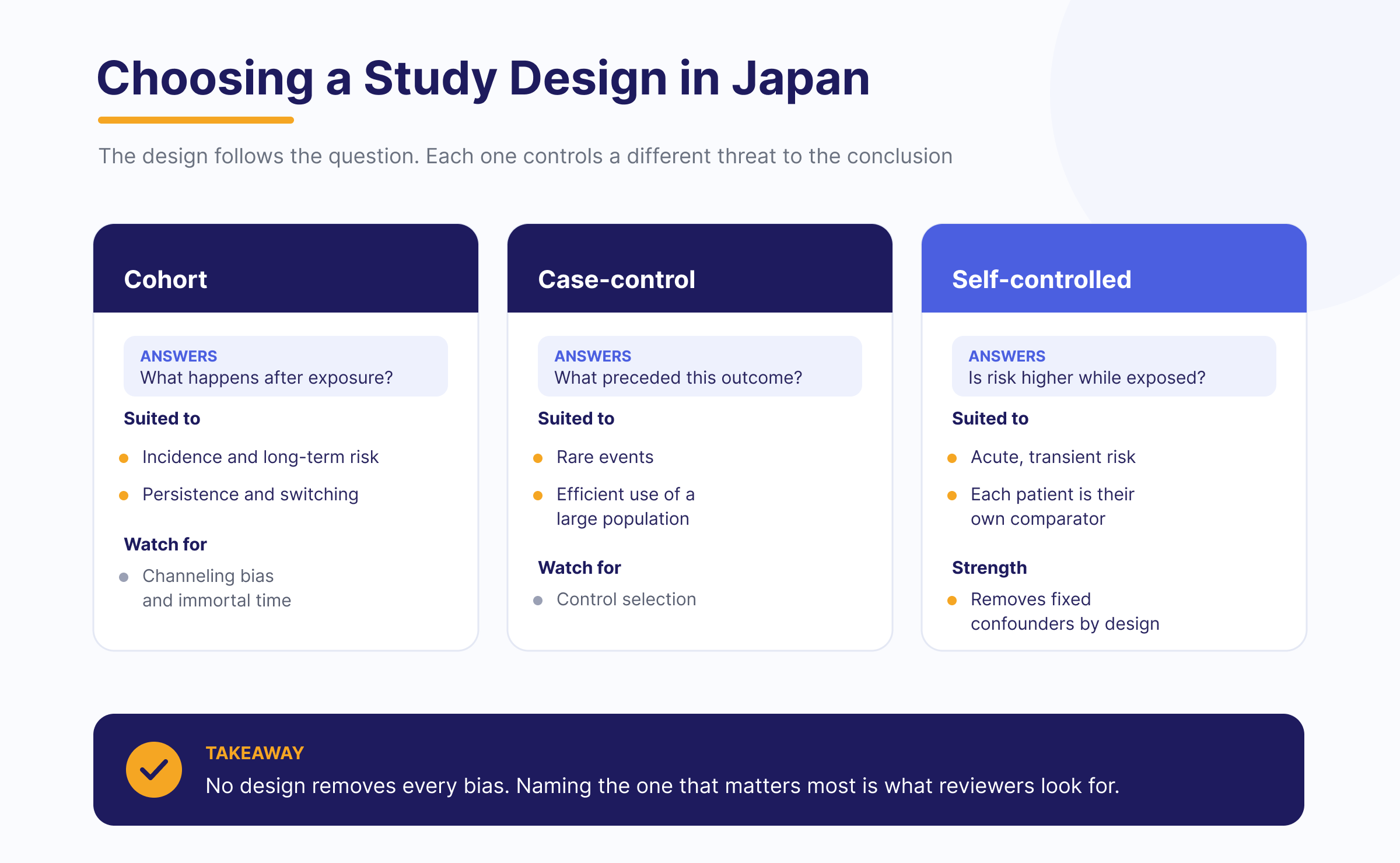
Design choice follows the decision being supported, and Japanese reviewers pay close attention to whether the two match. Cohort designs suit questions about incidence and long-term outcomes after a treatment starts. Case-control designs suit rare events where assembling a full cohort would be impractical. Self-controlled designs suit acute risks where each patient can serve as their own comparator, which removes confounding by stable patient characteristics without requiring that those characteristics be measured.
The recurring failure is an overstated conclusion rather than a poorly chosen design. Comparative effectiveness claims require that confounding be measurable, and when it is not, the honest output is a description of what happened rather than an estimate of what caused it. Teams that state that boundary explicitly tend to have easier regulatory conversations than those who leave it implicit. Reviewers are generally comfortable with acknowledged limitations and considerably less comfortable with an estimate presented as more certain than the data allows.
Outcome definitions deserve the same discipline. The need for outcome validation is assessed case by case in Japanese database studies. It matters most where an outcome is identified through a combination of diagnosis, procedure, and treatment codes, because measurement error there carries straight into the conclusion. Principles published by ISPOR provide a useful reference for documenting these decisions.
How the evidence is used across the lifecycle
Drug utilisation analysis is the most common application. It quantifies who receives a therapy and in what setting, dosing in routine care, concomitant therapy and polypharmacy, and switching and discontinuation patterns. Where Japanese prescribing diverges from Western markets, this is usually the fastest way to discover it, and the finding often reshapes assumptions that a global team had treated as settled.
Safety work runs alongside it. Pharmacoepidemiology identifies patterns that trials are too small or too short to reveal, including rare events, risks concentrated in specific subgroups such as elderly or renally impaired patients, and outcomes associated with particular drug combinations. This complements spontaneous adverse event reporting rather than replacing it. Spontaneous reports raise a hypothesis quickly but lack an exposure denominator, while database studies supply the denominator and the comparison that turn a signal into an assessment.
Health economic questions use the same records from a different angle. Resource utilisation, treatment persistence, downstream encounters, and the burden associated with switching or discontinuation are all visible in Japanese claims and hospital data. The main risk is importing assumptions, since reimbursement structures and care pathways differ enough from the US and EU that cost estimates rarely transfer without local adjustment.
Post-approval evaluation and health economics draw on the same foundation. Long-term effectiveness, safety over extended follow-up, utilisation shifts after a label change, resource use, and treatment burden are all tractable questions given the right dataset. Published case studies show how these analyses are typically assembled in practice.
Where this sits in Japan’s regulatory framework
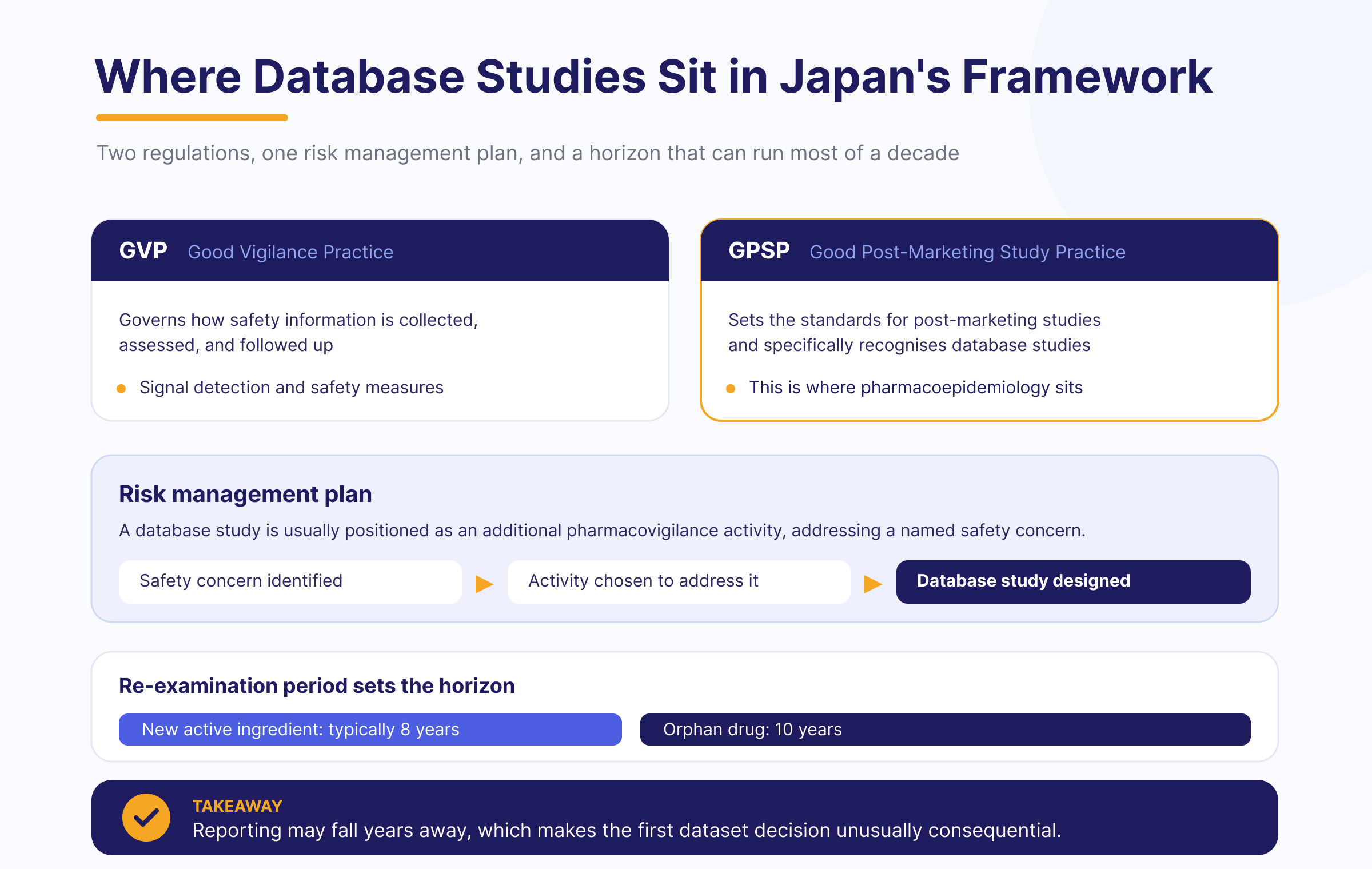
Japan’s post-marketing system gives pharmacoepidemiology a defined place. Good Vigilance Practice governs the collection, assessment, and follow-up of safety information, while Good Post-Marketing Study Practice sets the standards for post-marketing studies as a whole and specifically recognises database studies among them. In practice a database study is usually positioned as an additional pharmacovigilance activity within a risk management plan, addressing a named safety concern. The re-examination period, typically eight years for products containing a new active ingredient and ten years for orphan drugs, sets the horizon over which that evidence accumulates, so early dataset decisions carry consequences years into the future.
The regulator has also built specific capability. A cross-office RWD Working Group operated from April 2021 to September 2024, and points to consider for ensuring reliability when registry data supports approval and re-examination applications were issued in March 2021, supplemented by a question and answer document in September 2022. Its real-world data pages set out the current position.
Consultation routes covering epidemiological, registry, and database studies have been expanded progressively since 2017, so an evidence plan can be tested before it is executed. For a discipline where the expensive mistakes are made at the design stage, that opportunity is worth using. A cohort definition that no one questions until the analysis is finished is the most costly kind of oversight.
What makes these studies difficult
Access is the first constraint. High-value datasets involve governance review and approval steps that consume calendar time, and a post-approval commitment with a fixed deadline leaves little room to discover this late. Feasibility and access planning belong in the schedule from the beginning, alongside the scientific design rather than after it.
Data comparability is the second. Coding conventions, completeness, and documentation practice differ between institutions, so harmonisation is usually required before results can support a high-stakes decision. The third constraint is interpretive: medication use in Japan is shaped by local guidelines, reimbursement structures, and prescribing norms, and analysis without that context produces findings that are technically correct and practically misleading.
Linkage is the constraint that most often limits ambition. Nationwide claims follow a patient across institutions but thin out clinically, while hospital data carries more detail and stops at the network boundary. Deciding which of those compromises a study can tolerate is a design question, and it is far easier to settle before the cohort is built than to explain afterwards.
Practical recommendations for global teams
Teams that produce reliable pharmacoepidemiological evidence in Japan tend to concentrate on a few fundamentals:
- Start from the decision, then choose the design and the dataset that can actually support it
- Assess whether outcome validation is needed and, where appropriate, validate outcome definitions against clinical records
- State the limits of causal interpretation explicitly, particularly where confounding cannot be measured
- Document cohort definitions, index dates, follow-up windows, and sensitivity analyses as the study is designed
- Work with local partners who understand Japanese prescribing practice, coding, and data access pathways
None of this is unique to Japan as a methodological matter. What is specific is how consistently these points are examined, and how much weight documentation carries when the evidence eventually supports a regulatory decision.
Japan’s growing influence in global pharmacoepidemiology
Broad coverage, strong post-marketing expectations, and expanding data availability have made Japan one of the more productive environments for medication research, and the volume of database-based work reflects that. A 2025 review of 674 applications approved between 2019 and 2024 found that 23.4% contained real-world data or evidence, with the annual share rising from 18.1% in 2019 to 30.4% in 2024, and post-marketing database studies now form a substantial share of planned surveillance activity. For global sponsors the practical conclusion is to treat Japan as a distinct evidence ecosystem, not an extension of an existing programme. Selecting fit-for-purpose datasets, applying methods matched to the claim, and grounding results in local clinical practice produces evidence that strengthens safety strategy and lifecycle management, and that holds its value outside Japan as well. Recent published work from Japanese datasets increasingly appears in international literature for the same reas

For More Information, Please Contact Us Here
About Japanese Healthcare System

What you need to know about the healthcare system in Japan before using the data.
SERVICE
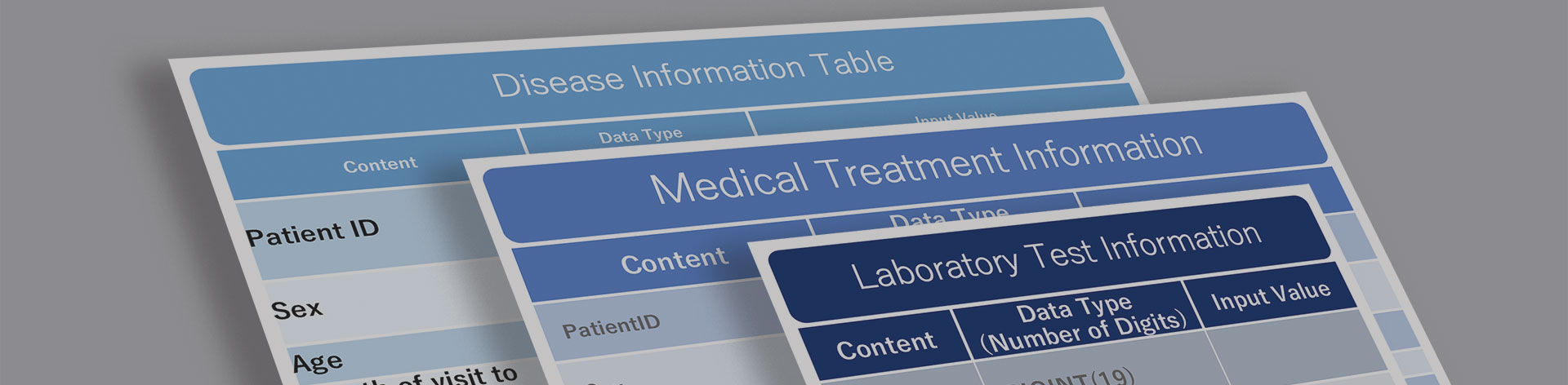
In addition to various web tools that allow you to easily conduct surveys via a browser using our medical database, we offer data provision services categorized into four types to meet your needs and challenges: "Analysis reports" "Datasets," "All Therapeutic Areas Data Provision Service," and "Specific Therapeutic Areas Data Provision Service.


© Medical Data Vision Co., Ltd. All Rights Reserved.