



A Practical Guide to Real-World Data in Japan for Research and Development Teams
Japan is the world’s third-largest pharmaceutical market, valued at approximately USD 86 billion in 2025, and its use of real-world data (RWD) is accelerating: the share of regulatory applications containing RWD or real-world evidence rose from 18.1% in 2019 to 30.4% in 2024. For global pharma teams, the challenge is rarely whether usable data exists; it is knowing which of Japan’s many datasets fits the question being asked.
Japan’s sources vary widely in access, clinical depth, and how well they reflect real care. This guide breaks down the main RWD sources in Japan, what each is best used for, and how to apply them across the drug lifecycle, from early epidemiology through post-market surveillance. Throughout, one principle recurs: the value of RWD in Japan depends less on the size of a dataset than on how well it is matched to the decision at hand.
Why RWD is becoming central to healthcare and research in Japan
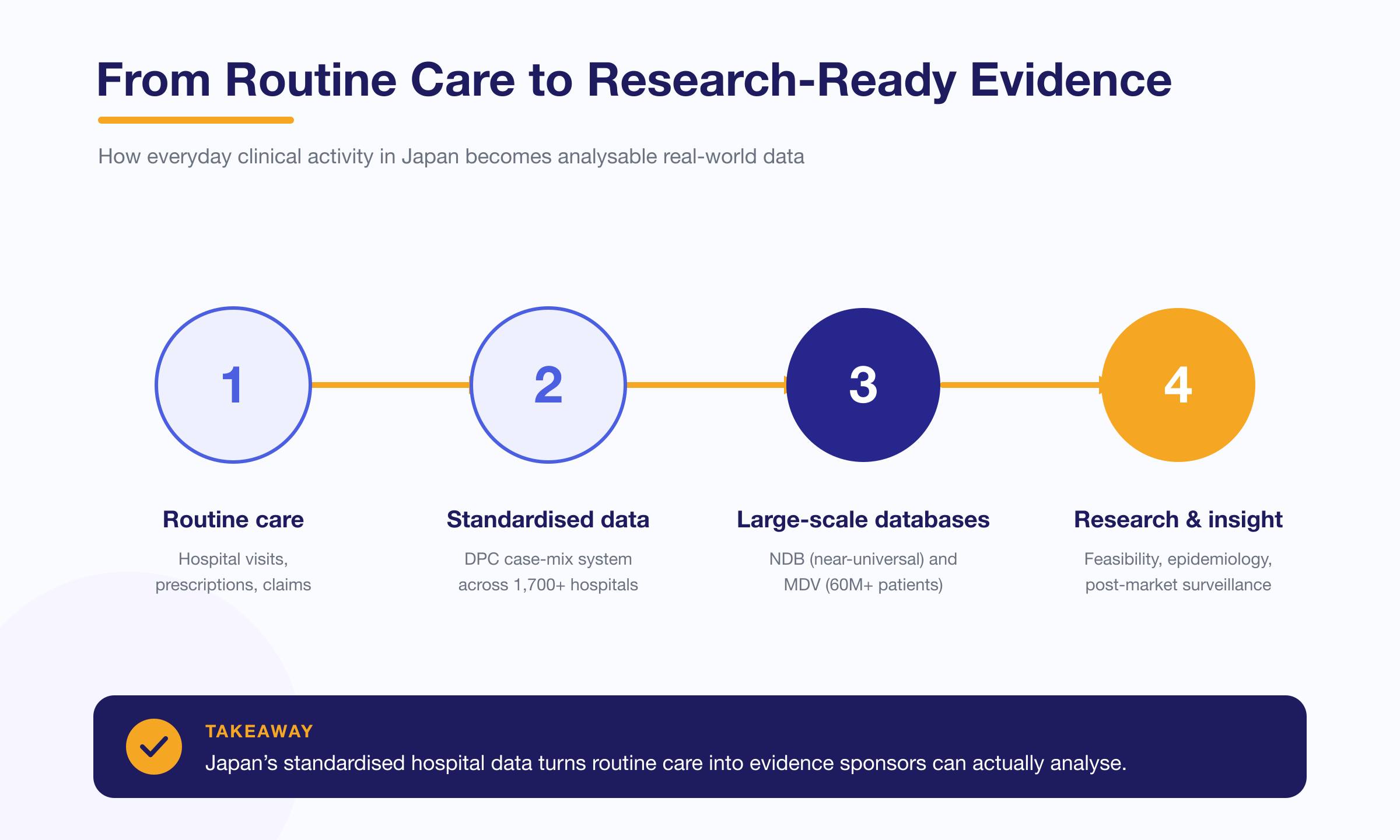
Japan’s healthcare system generates large volumes of structured data, and the value of using it is increasingly clear. A universal insurance model captures healthcare utilisation across almost the entire population, while the DPC case-mix system, adopted by over 1,700 acute care hospitals covering more than half of all acute inpatients, standardises much of the hospital data that underpins research.
Used well, RWD can help teams:
- Estimate patient populations more realistically
- Understand how care is delivered outside trial settings
- Identify regional variation in treatment and outcomes
- Support evidence generation after approval
Japan is also a market where real-world evidence is particularly relevant, given an aging population, with roughly 29% aged 65 or over, and complex long-term disease management. For global sponsors, that makes RWD useful well beyond local strategy: it feeds broader lifecycle planning too. That mix of local insight and global relevance is why more sponsors now build a Japan RWD strategy early rather than late.
What makes Japan’s RWD environment unique?
Japan’s RWD environment has several characteristics that shape how data can be used for research.
A national insurance system with broad coverage
Japan’s universal health insurance model supports consistent capture of healthcare utilisation across much of the population. This makes claims-based datasets, most notably the National Database (NDB), especially valuable for population-level analyses such as prevalence estimation, treatment patterns, and healthcare resource use.
Strong claims data, but variable clinical depth
Japan has high-quality claims infrastructure compared with many markets. However, claims data alone often lacks clinical detail such as disease severity, lab values, imaging results, and clinician-reported outcomes. To answer more clinical questions, teams usually need EMR or registry data that records what actually happens at the point of care.
Digitisation disparities across hospitals
While many hospitals maintain electronic medical records, the level of standardisation varies across institutions and networks, making EMR datasets harder to harmonise and compare for multi-site research. Large standardised hospital databases help close this gap: MDV’s database, covering over 60 million patients across 618 DPC hospitals, applies consistent structure across contributing sites and makes cross-hospital analysis far more practical.
Main sources of RWD in Japan
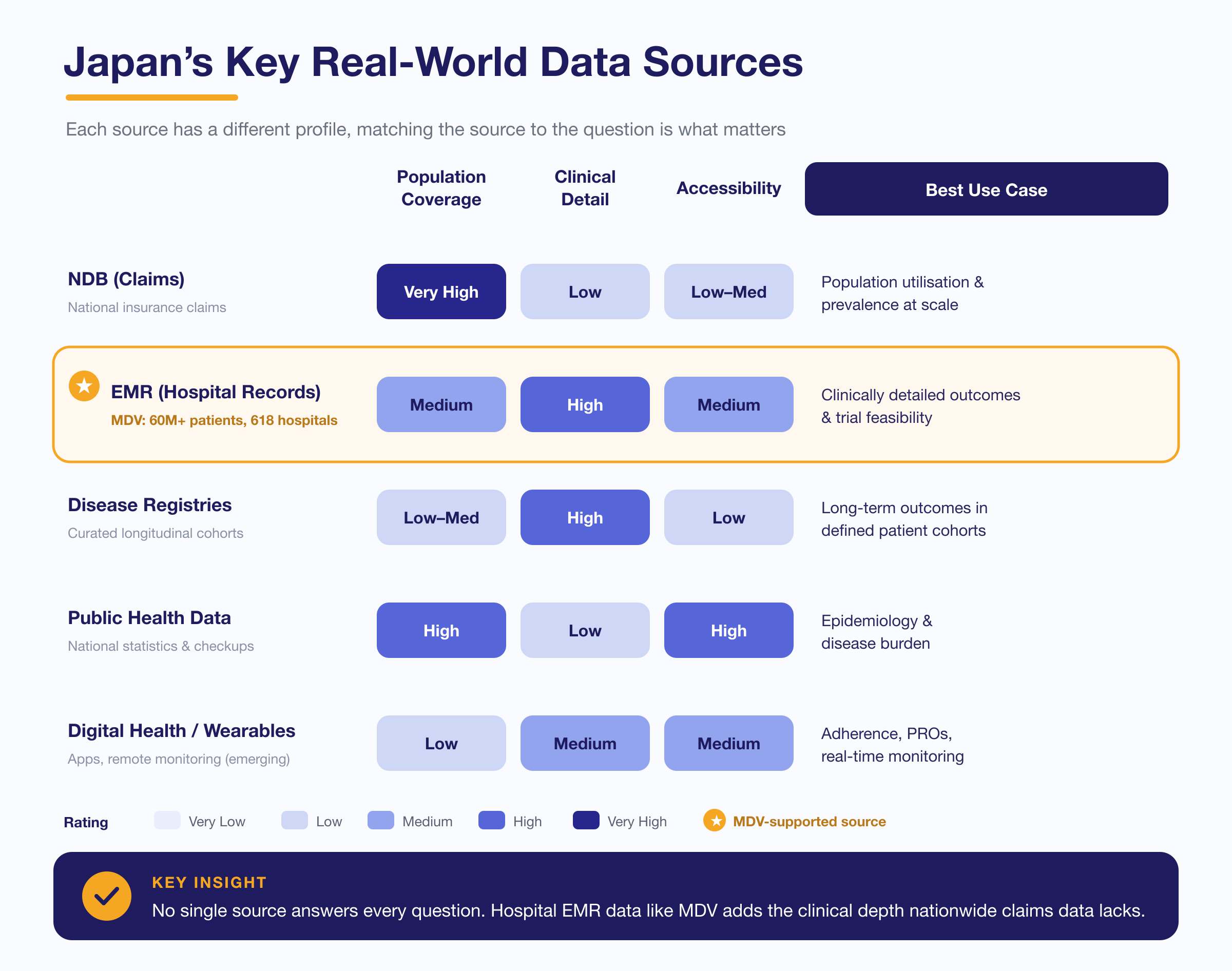
Japan has multiple RWD sources that support different research and development needs, each with trade-offs in scale, granularity, and feasibility of access. The table above summarises how the main sources compare; the sections below add detail.
NDB claims data
The National Database of Health Insurance Claims and Specific Health Checkups (NDB) is one of Japan’s most important population-level datasets, covering virtually the entire insured population. It is particularly useful for prevalence and incidence estimation, treatment-pattern and switching analysis, healthcare utilisation and cost proxies, and broad patient-pathway mapping.
Its limitations, restricted access and limited clinical detail, can constrain endpoint selection and confounding adjustment, so NDB is often best combined with more granular sources. In practice, many teams use NDB to size a question at the population level, then turn to EMR or registry data to answer the clinical detail it cannot capture.
EMR datasets from hospital systems and networks
EMR data provides richer clinical information than claims, including lab results, procedures, and clinician-recorded outcomes. Hospital-based databases such as MDV, the most frequently used database in post-marketing studies in Japan, according to a 2026 study in Clinical and Translational Science (Okami et al.), make this depth available at scale. EMR data can be valuable for:
- Trial feasibility assessments (eligibility criteria realism)
- Outcome definitions tied to clinical measures
- Subgroup analysis where clinical variables are available
- Protocol optimisation based on real care patterns
Challenges include variation in coding, missingness, and incomplete capture of care delivered outside the contributing hospital network. For global teams, the practical implication is that a large, consistently structured EMR source can substantially shorten the analytical work needed before results are trustworthy across sites.
Disease registries
Japan maintains disease registries that can support longitudinal tracking, particularly in oncology and rare diseases. They may be useful for natural-history studies, long-term outcomes analysis, post-approval evidence generation, and external comparator development (with careful design).
Registry structure, completeness, and access vary widely, so feasibility checks are essential early on.
Public health datasets
Japan also has public datasets that can support contextual analysis, such as demographic and population health statistics, disease surveillance reporting where applicable, and health-system capacity indicators. These sources may not be sufficient for patient-level research, but they can strengthen epidemiology framing and market understanding.
Digital health and wearable data
Digital health data is emerging as a complementary source in Japan. While not always suitable for regulatory-grade endpoints, it can support adherence and persistence insights, symptom tracking and patient-experience measures, and remote monitoring in hybrid models. These datasets require careful validation and may be difficult to integrate with traditional clinical records.
How RWD supports research and development activities
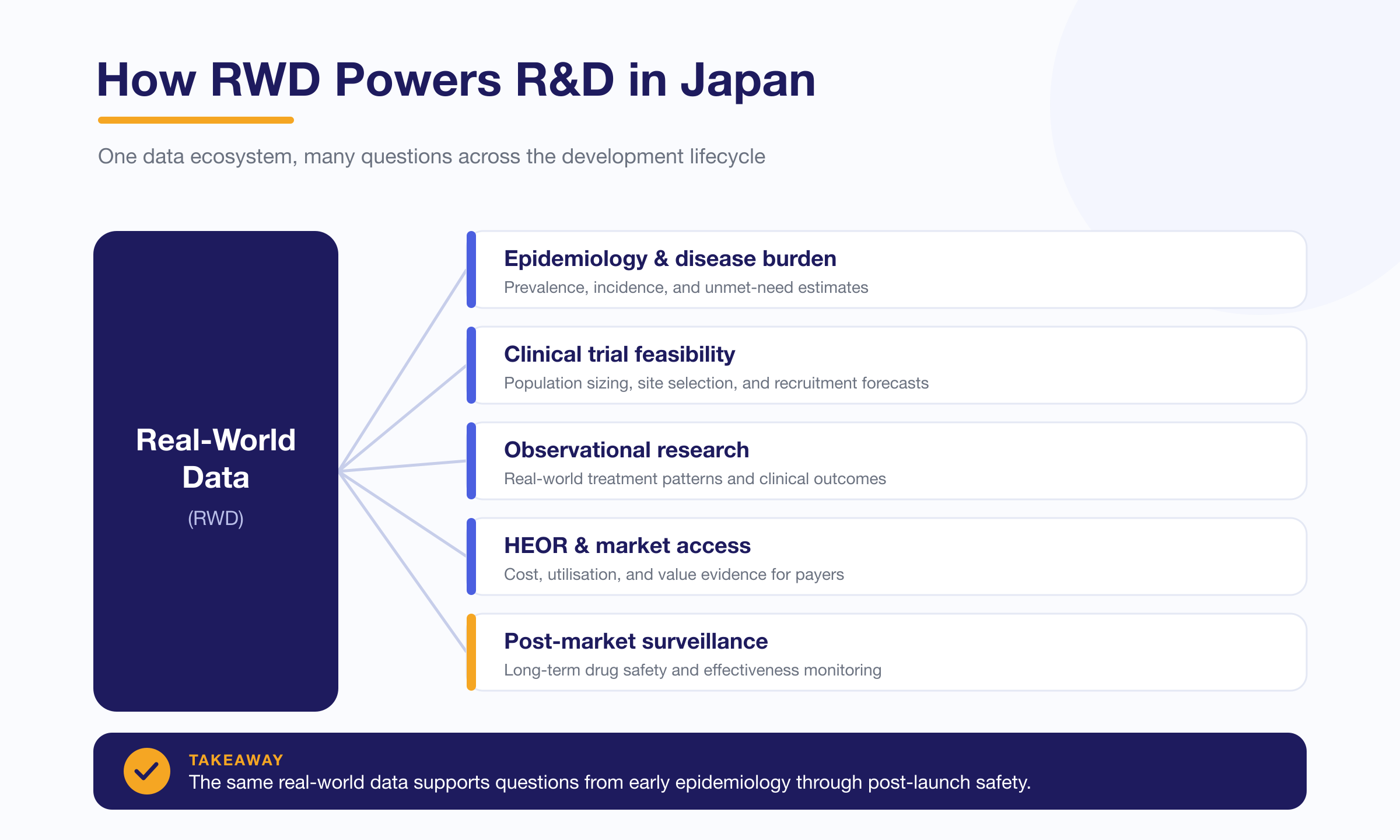
RWD in Japan can support multiple activities across the lifecycle. The most successful projects start with a narrow decision question and select the dataset accordingly.
Epidemiology and disease burden estimation
Claims and population datasets can help quantify disease burden: estimated patient populations by diagnosis, treatment uptake and sequencing, and comorbidity and utilisation patterns. This work often supports early portfolio planning and evidence strategy in Japan. Getting this picture right early helps teams prioritize indications and avoid committing resources to populations that turn out to be smaller than assumed.
Clinical trial feasibility and protocol planning
In Japan, RWD is most practical for feasibility planning. Teams can use RWD to estimate how many patients meet proposed criteria, stress-test assumptions about lines of therapy, identify typical lab testing frequency and visit cadence, and forecast recruitment timelines by region or site type. This can reduce late protocol amendments and improve site selection decisions.
Observational research and real-world evidence generation
Japan’s healthcare datasets can support observational studies such as treatment pattern analysis, comparative effectiveness (where feasible and appropriate), natural history and progression analysis, and outcomes research in broader real-world populations. The main constraints, confounder availability and outcome-capture quality, differ by dataset type.
HEOR and market access insights
RWD can contribute to health economics and outcomes research by providing resource-utilisation patterns, treatment persistence and discontinuation insights, downstream healthcare encounters as proxies for burden, and real-world comparators that reflect Japanese practice. For global teams, the key is to avoid assuming that cost structures and care pathways mirror the US or EU. Grounding value arguments in Japanese real-world utilisation, rather than extrapolated assumptions, tends to make them far more persuasive with local payers.
Post-market surveillance and safety monitoring
Japan has a strong post-marketing culture, and RWD increasingly underpins it: post-marketing database studies now account for 18.9% of all planned post-marketing surveillance activities as of 2024. RWD supports long-term safety monitoring, detection of rare events in larger populations, risk minimisation and utilisation tracking, and evidence generation aligned with post-approval commitments. This is also the RWD use case that regulators are most comfortable with.
Opportunities for global teams
Japan’s RWD ecosystem offers several strategic opportunities for non-Japan development teams.
Longitudinal insight in an aging population
Japan’s demographics create opportunities to study outcomes in older and comorbid populations that may be underrepresented in clinical trials. This can strengthen benefit–risk understanding and inform post-approval strategies.
Clearer visibility into real practice patterns
RWD can reveal how treatment sequencing and monitoring differ from Western markets. For global teams, this supports better localisation of trial design and evidence planning.
Growing acceptance of data-supported evidence
While Japan remains methodologically rigorous, there is increasing openness to using RWD as supportive evidence when the approach is transparent and fit for purpose. In April 2021, PMDA established a dedicated RWD Working Group spanning new drug review, safety, medical informatics, and epidemiology, a clear signal of institutional commitment to data-driven regulatory science.
Challenges in Japan’s RWD landscape
Despite strong data assets, there are practical challenges that affect timelines and study design.
Limited interoperability and dataset fragmentation
Different datasets capture different parts of the patient journey. Claims offer scale, while EMRs offer clinical detail. Linkage may not always be possible, and endpoint capture can be inconsistent across sources. Planning around this fragmentation from the outset, rather than discovering it mid-study, is often what separates smooth projects from stalled ones.
Data access constraints
High-value datasets may require complex approvals, contractual steps, and governance review. Feasibility planning should include realistic time allowances for access.
Privacy and compliance considerations
Japan’s privacy requirements must be handled carefully, particularly for datasets that include sensitive clinical information or require linkage across sources. Clear governance and documentation are essential.
Best practices for working with RWD in Japan
Global teams can reduce risk and improve output quality by following a few practical principles.
Choose datasets that are fit for purpose
Start with the decision question, then work backwards and match the data source to it:
- Claims data for scale, prevalence, and broad utilisation
- EMR data for clinical variables and endpoint feasibility
- Registries for longitudinal outcomes in defined cohorts
- Post-market datasets for safety and real-world monitoring
Avoid choosing datasets based only on availability.
Collaborate with local experts early
Local partners can help interpret clinical coding, care pathways, and operational constraints. This is especially important when translating clinical definitions into computable endpoints.
Prioritise methodological transparency
RWD outputs are most useful when the study logic is clear and reproducible. Teams should document:
- Cohort definitions and index dates
- Exposure and outcome logic
- Follow-up windows and censoring
- Confounder handling and sensitivity analyses
- Known limitations and potential biases
Japan’s expanding RWD ecosystem and its strategic value
Japan’s real-world data ecosystem continues to expand in scale and relevance, and the trajectory is clear: RWD/RWE now features in roughly a third of new regulatory applications. For global pharma teams, RWD offers a practical way to reduce uncertainty in trial planning, generate evidence that reflects Japanese clinical practice, and support post-approval strategy.
Teams that treat Japan RWD as a strategic capability, rather than a one-off dataset exercise, are better positioned to generate evidence that is credible, actionable, and aligned with local expectations.

For More Information, Please Contact Us Here
About Japanese Healthcare System

What you need to know about the healthcare system in Japan before using the data.
SERVICE
In addition to various web tools that allow you to easily conduct surveys via a browser using our medical database, we offer data provision services categorized into four types to meet your needs and challenges: "Analysis reports" "Datasets," "All Therapeutic Areas Data Provision Service," and "Specific Therapeutic Areas Data Provision Service.


© Medical Data Vision Co., Ltd. All Rights Reserved.