



Clinical Research in Japan: Key Insights for Global Pharma and Development Teams
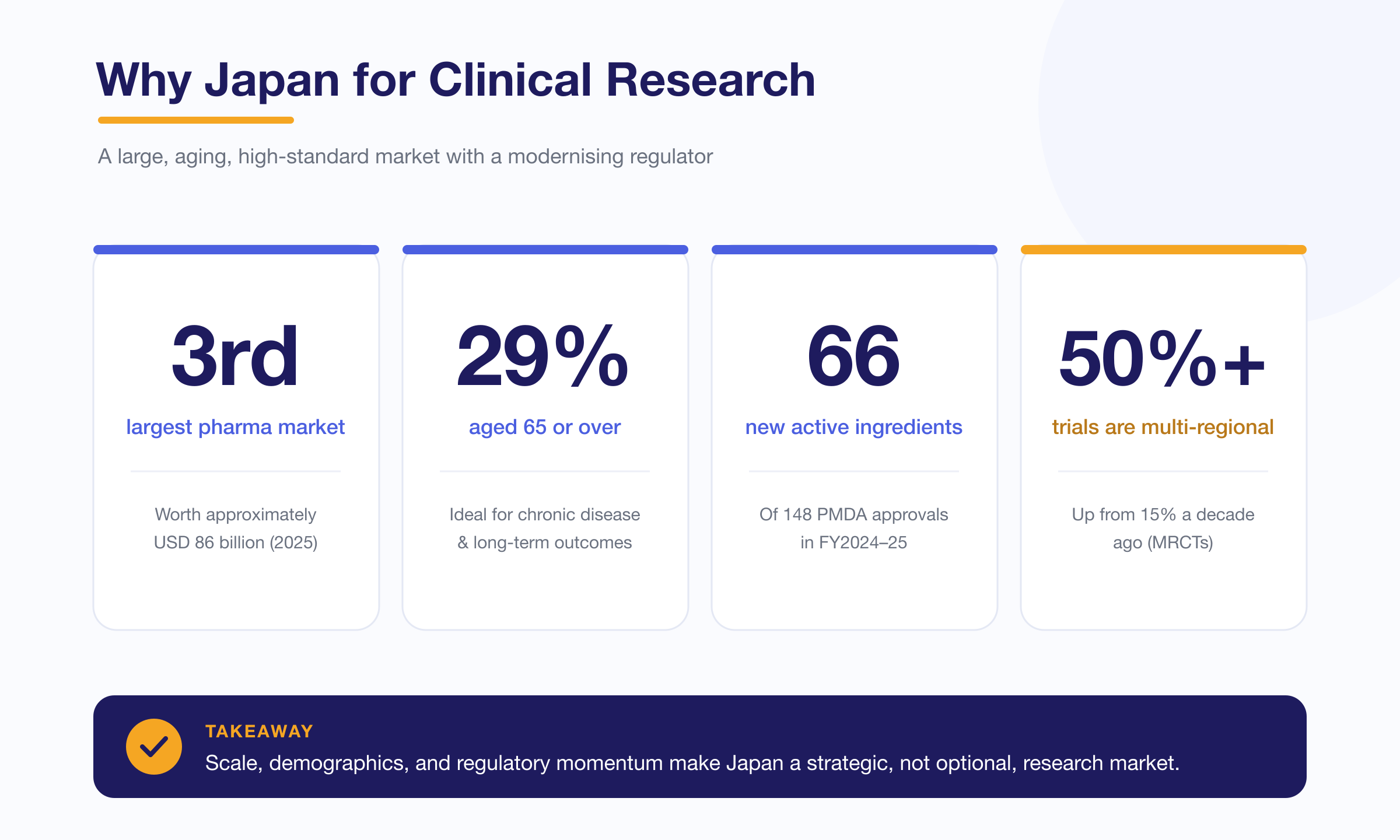
Japan continues to play an important role in global clinical development. It is the world’s third-largest pharmaceutical market (approximately USD 86 billion in 2025), with strong clinical standards, highly trained investigators, and access to patient populations that can differ meaningfully from Western cohorts. In FY2024–25, PMDA issued 148 total drug approval decisions, of which 66 were new active ingredients. Japan’s aging demographics, with approximately 29% of the population aged 65 or over, and complex treatment pathways also make it a valuable environment for understanding long-term outcomes and real-world safety considerations.
Given these characteristics, Japan is a strategically important setting in its own right, where high-quality evidence can shape both regional and global development decisions. For global sponsors, clinical research in Japan requires more than regulatory awareness. It demands practical planning around site capabilities, recruitment dynamics, documentation standards, and local execution expectations.
This article outlines Japan’s clinical research landscape, the PMDA regulatory framework, infrastructure and operational considerations, and best practices for running successful studies in Japan.
Why Japan remains a crucial market for clinical research
Japan’s clinical research relevance is shaped by a combination of scientific, demographic, and commercial drivers.
- Scientific value: Japanese clinical practice and patient characteristics may differ from Western settings, strengthening global evidence packages when studied appropriately.
- Demographic relevance: An aging population supports research in chronic disease and long-term treatment exposure.
- Strategic market importance: Japan is a high-priority market for many global launches, making Japan-specific evidence and execution readiness essential.
For many development programs, Japan is more than a regulatory requirement: it is a market where local trial success directly supports broader lifecycle strategy, access planning, and long-term evidence generation.
Overview of Japan’s clinical research environment
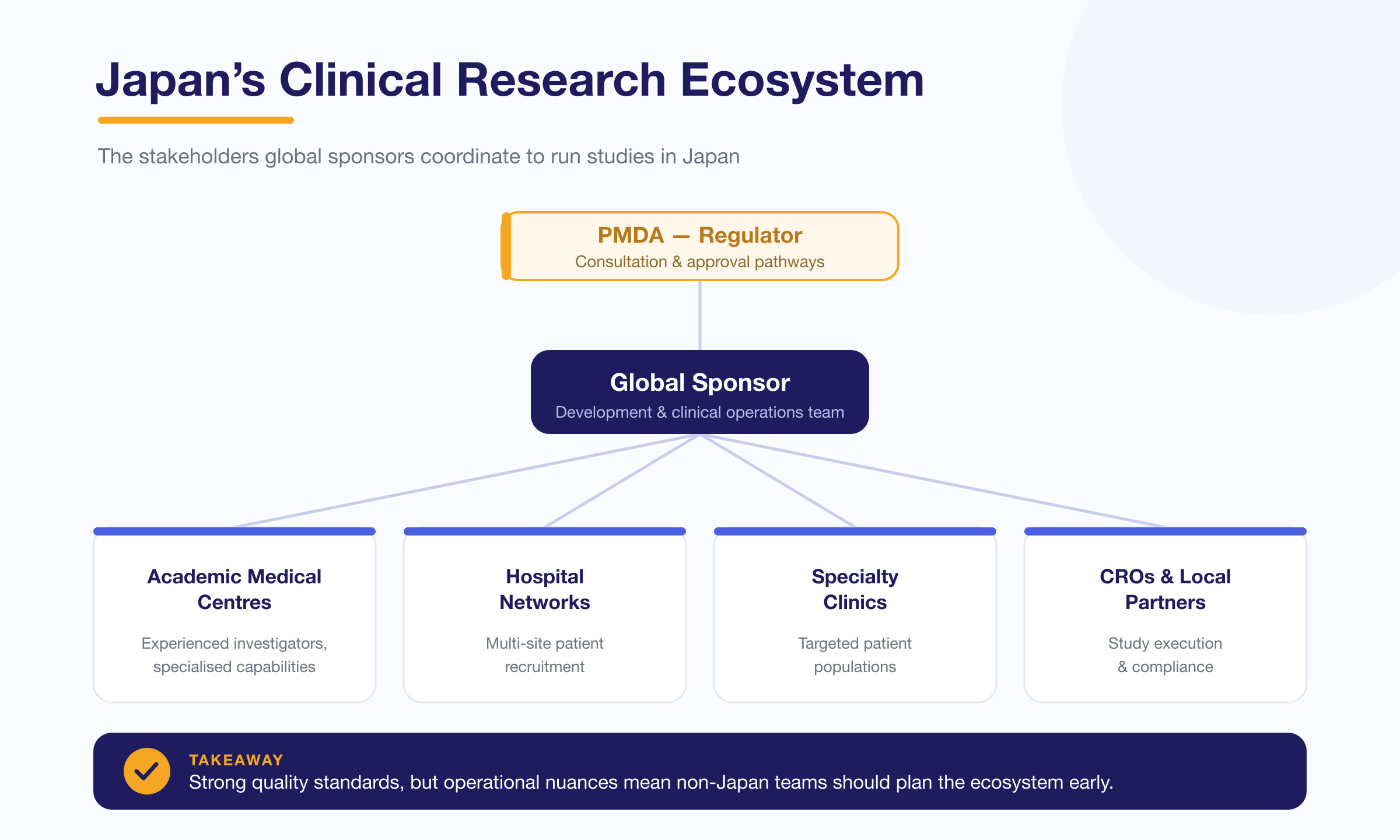
Japan’s clinical research ecosystem is built on a combination of academic institutions, research hospitals, and specialised clinical sites, supported by contract research organisations (CROs) and dedicated clinical operations teams. This structure enables high-quality trial execution, but also introduces operational nuances that global teams must understand early.
Key players in Japan’s trial landscape
Global sponsors typically collaborate with a range of stakeholders, each contributing distinct capabilities:
- Academic medical centres with experienced investigators and specialised capabilities
- Large hospital networks supporting multi-site recruitment
- Specialty clinics that may support targeted patient populations
- CROs and local operational partners supporting study execution and compliance
Japan’s environment is known for strong quality standards, but operational differences may require additional planning for non-Japan teams.
Historical context and recent evolution
The landscape is evolving. Japan has become an increasingly active participant in multi-regional clinical trials (MRCTs), with its participation in phase III oncology MRCTs rising from 34.3% in 2008–2012 to 60.2% in 2018–2022. There is increasing focus on improving trial efficiency, modernizing workflows, and expanding the role of data and digital tools in feasibility planning and study monitoring. Recent regulatory developments have increased the flexibility to use overseas clinical data and global clinical trial results in Japanese development programs, potentially reducing the need for Japan-specific studies in certain circumstances. As a result, Japan is becoming more accessible, while still maintaining its emphasis on quality.
Japan’s clinical research regulatory framework
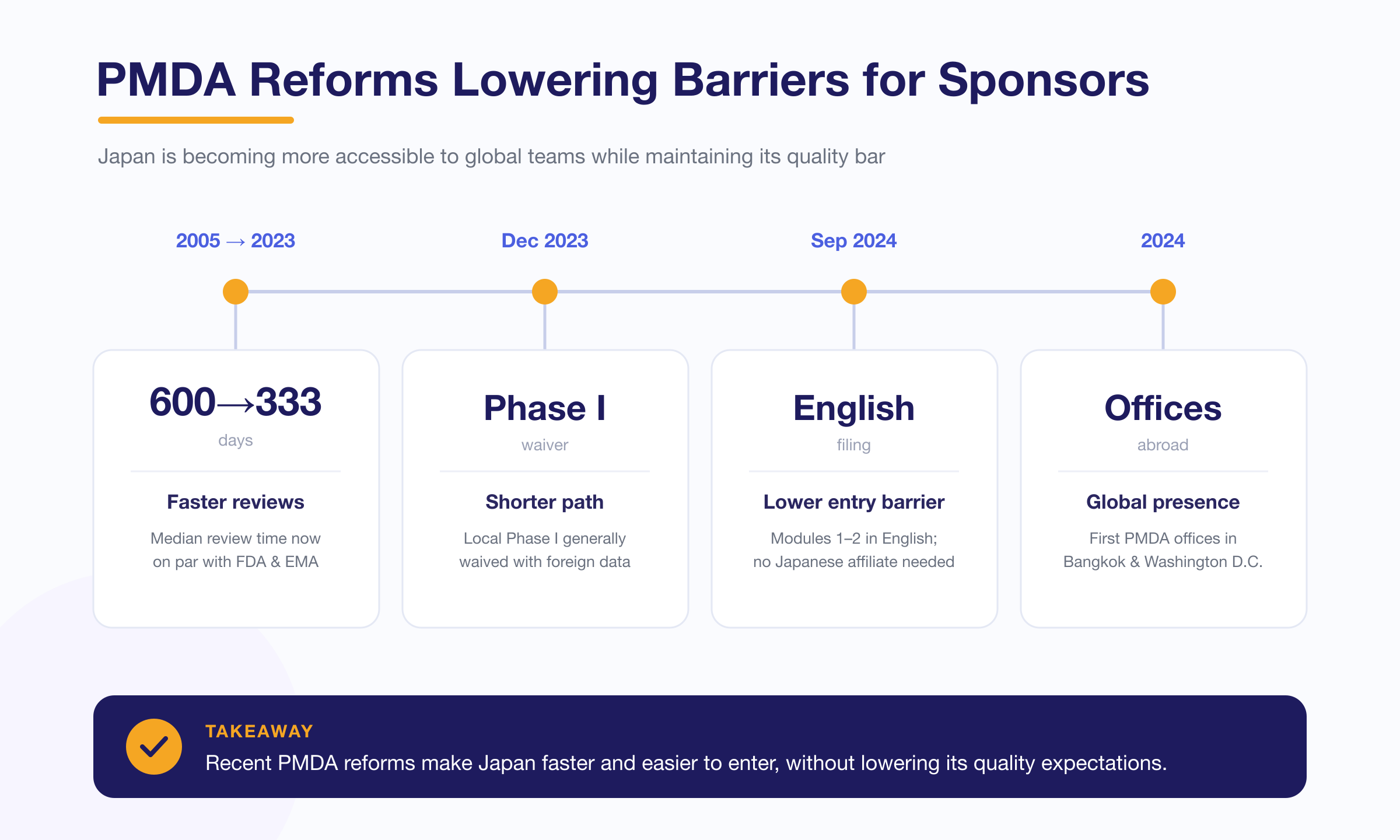
Japan’s regulatory environment is a central component of clinical development planning. The Pharmaceuticals and Medical Devices Agency (PMDA) plays a key role in shaping study design, evidence expectations, and approval pathways. The median total review time has improved significantly, from over 600 days in 2005 to 333 days in 2023. For global teams, early and proactive engagement with the PMDA is often a critical success factor.
PMDA processes and consultation pathways
PMDA consultation pathways provide structured opportunities for alignment at key stages of development. These interactions help clarify expectations and reduce downstream risk, typically covering development strategy and evidence planning, study design considerations in Japan, endpoint relevance and local feasibility assumptions, and post-approval expectations and evidence generation plans.
PMDA’s broader emphasis on regulatory science supports data-driven development approaches when evidence is transparent and fit for purpose. PMDA also engages with the FDA’s Project Orbis initiative for concurrent oncology reviews as an observer, while the initiative’s full partners are TGA (Australia), Health Canada, MHRA (UK), HSA (Singapore), ANVISA (Brazil), Swissmedic (Switzerland), and Israel’s Ministry of Health.
GCP compliance requirements
Japan follows Good Clinical Practice (GCP) standards, with particularly high expectations for compliance and documentation. This has important implications for operational planning. Sponsors should be prepared for:
- Strong documentation discipline across all trial activities
- Clear role definition between global and local teams
- Robust quality oversight and audit readiness
- Consistent processes for safety reporting and monitoring
In practice, operational success often depends on how well global systems and processes are adapted to meet Japan-specific expectations.
Review timelines and documentation expectations
Regulatory submissions in Japan require detailed preparation and well-supported evidence narratives, with greater emphasis on documentation completeness and internal consistency than in some other regions. Notably, from September 2024, PMDA now accepts Modules 1–2 of submissions in English for sponsors without a Japanese affiliate, removing a significant operational barrier for global sponsors. Teams should plan for:
- Local documentation requirements and translation needs
- Alignment between global and Japan-specific submissions
- Clear justification of study design decisions and evidence sources
Investing in early planning can significantly reduce the risk of delays, queries, and rework during the review process.
Infrastructure supporting successful trials
Japan has a well-developed infrastructure for clinical research, particularly in major research hospitals and specialty centres. This infrastructure underpins the country’s reputation for high-quality data and reliable study execution.
Research hospitals and site capabilities
Many of Japan’s leading research sites offer a combination of clinical expertise and operational strength. Common characteristics include:
- Experienced investigators and dedicated research staff
- Strong clinical standards and disciplined patient follow-up
- High-quality data capture and documentation practices
- Deep expertise in specific therapeutic areas
While patient volume is an important consideration, site selection should also account for operational fit, past performance, and alignment with study requirements.
Patient registry availability
Disease registries can support feasibility planning and evidence development, especially in oncology and rare diseases, providing structured cohort definitions, longitudinal follow-up, and clinically rich variables (depending on design).
Registry governance and access vary, so feasibility assessment is important early. In addition to disease-specific registries, large-scale hospital claims databases such as those covering over 60 million patients from 618 DPC hospitals provide structured data that can support feasibility analysis and site identification across therapeutic areas.
Digital health tools and data-driven operations
Japan is increasingly incorporating digital tools into clinical research workflows, helping to improve both planning and execution. They support:
- Feasibility analysis using real-world datasets
- Recruitment planning and site performance tracking
- Remote monitoring and hybrid study models, where appropriate
Although adoption levels differ across institutions, the overall direction is toward more data-driven and technology-enabled trial operations.
Key factors influencing trial performance in Japan
Despite strong infrastructure, trial performance in Japan depends on several practical and context-specific factors. Understanding these early can help mitigate risk and improve execution.
Patient recruitment characteristics
Recruitment dynamics in Japan can differ significantly from Western markets, reflecting both system structure and clinical practice patterns. Key considerations include:
- Concentration of eligible patients in specific centres
- Referral pathways that may limit direct patient access
- Treatment sequencing shaped by local clinical norms
- Higher prevalence of older, comorbid populations in certain indications
As a result, recruitment planning should be based on Japan-specific feasibility data rather than assumptions from other regions. Japan’s DPC system, adopted by over 1,700 acute care hospitals (covering over 50% of all acute care inpatients), generates structured claims and discharge data that can support evidence-based recruitment planning and site selection.
Site performance variability
Not all sites perform equally, even within a high-quality system. Variability can arise from patient access and institutional workflows, competing study commitments, research staffing capacity, and experience working with global sponsors.
Using historical performance data and local insights can help optimise site selection and reduce activation delays.
Cultural considerations in patient engagement
Patient engagement strategies should be adapted to local expectations and communication styles; approaches that work in one region may not translate directly to Japan. Important considerations include:
- Ensuring materials are culturally appropriate and clearly explained
- Supporting investigator-led communication where preferred
- Minimising patient burden through realistic visit schedules
Using RWD to strengthen feasibility analysis
Real-world data (RWD) is an increasingly valuable tool for feasibility planning, allowing sponsors to ground assumptions in actual clinical practice. RWD can support:
- Estimation of eligible patient populations under real criteria
- Analysis of treatment pathways and lines of therapy
- Site selection based on actual patient volumes
- Forecasting of recruitment timelines
Large-scale datasets, such as Japan’s NDB for population-level insight and hospital-based databases like MDV, the most frequently used database in post-marketing studies according to a 2026 study in Clinical and Translational Science, can provide patient-level insights that strengthen feasibility assessments and reduce uncertainty.
Opportunities for global pharma sponsors
Japan offers several advantages for global development teams:
- High-quality sites and investigators with strong clinical standards
- Potential for strong investigator relationships that support long-term development programs
- Strategic alignment with Asia-Pacific development and regional evidence planning
- Locally relevant evidence generation supporting launch readiness and lifecycle strategy
For many sponsors, Japan is also a key market for post-approval evidence and long-term safety monitoring.
Challenges in conducting clinical research in Japan
While the opportunities are significant, global teams should also be aware of common challenges. These are often operational rather than scientific, but can still affect timelines and outcomes. Typical challenges include:
- Recruitment difficulty in competitive or specialised indications
- High documentation complexity and operational discipline requirements
- Workflow differences compared with Western trial models
- Feasibility uncertainty when local care pathways differ from global assumptions
Best practices for running successful studies in Japan
Successful studies in Japan are typically built on a combination of early alignment, strong partnerships, and disciplined execution. Rather than relying on global templates alone, teams benefit from adapting their approach to local realities. Key best practices include:
- Engaging early with the PMDA to align on development strategy and evidence expectations
- Building strong site networks and investing in relationship-based site management
- Using RWD in feasibility planning to reduce recruitment and protocol risk
- Integrating digital tools thoughtfully to improve monitoring and reduce burden
- Maintaining transparent documentation and robust quality oversight throughout the study
Global best-practice frameworks can also support consistency in observational methods and evidence development where RWD is used.
Japan’s growing role in global clinical development
Japan remains a high-value market for clinical research, combining strong clinical quality with increasing capability in data-driven trial planning. PMDA’s opening of its first-ever overseas offices in Bangkok and Washington D.C. in 2024 further signals Japan’s commitment to attracting global sponsors and reducing barriers to clinical development. Its role in global development continues to evolve as data availability and digital tools expand.
For global pharma teams, success depends on aligning with PMDA expectations, selecting appropriate sites, and building Japan-specific feasibility and operational strategies. Teams that invest early in local insight, evidence planning, and execution readiness are best positioned to run efficient studies and generate evidence that supports both Japanese approval and broader global development goals.

For More Information, Please Contact Us Here
About Japanese Healthcare System

What you need to know about the healthcare system in Japan before using the data.
SERVICE
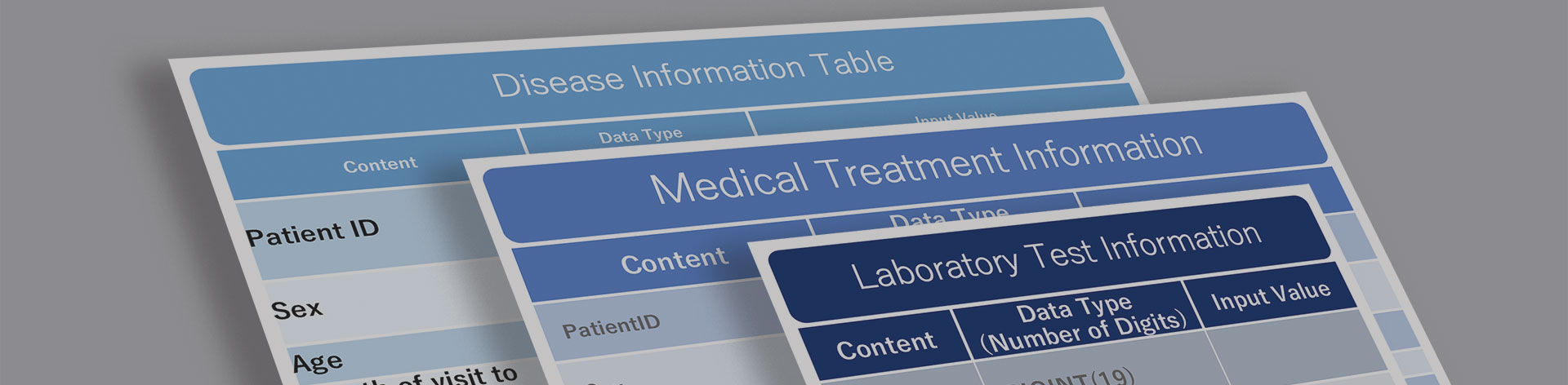
In addition to various web tools that allow you to easily conduct surveys via a browser using our medical database, we offer data provision services categorized into four types to meet your needs and challenges: "Analysis reports" "Datasets," "All Therapeutic Areas Data Provision Service," and "Specific Therapeutic Areas Data Provision Service.


© Medical Data Vision Co., Ltd. All Rights Reserved.