



A new approach to safety surveillance under the revised pharmacovigilance Decision Tree
Beyond studies: toward scientifically driven pharmacovigilance
In July 2024, the MHLW issued a partial revision to the “Approach to Developing Implementation Plans for Post-Marketing Surveillance of Pharmaceuticals.” This revision represents a major turning point in the practical conduct of safety surveillance activities. Even prior to the revision, the guidance had already moved away from a study-driven approach and toward the selection of scientifically appropriate safety monitoring activities. The latest revision takes this concept a step further, placing greater emphasis on scientific reasoning in the design of post-marketing safety strategies.
The changes directly affect day-to-day pharmacovigilance practice, including the role of post-marketing surveys and the conditions under which post-marketing database studies may be conducted. At the same time, the revision reflects a more fundamental shift in mindset that is not always immediately apparent from the wording of the guidance alone and has led to some uncertainty in practice. In this article, we introduce the updated pharmacovigilance Decision Tree, a regulatory decision-making framework issued by Japan’s Ministry of Health, Labour and Welfare (MHLW) to guide the selection of post-marketing safety surveillance activities and systematically examine what the revision means and how it is likely to influence pharmacovigilance practice.
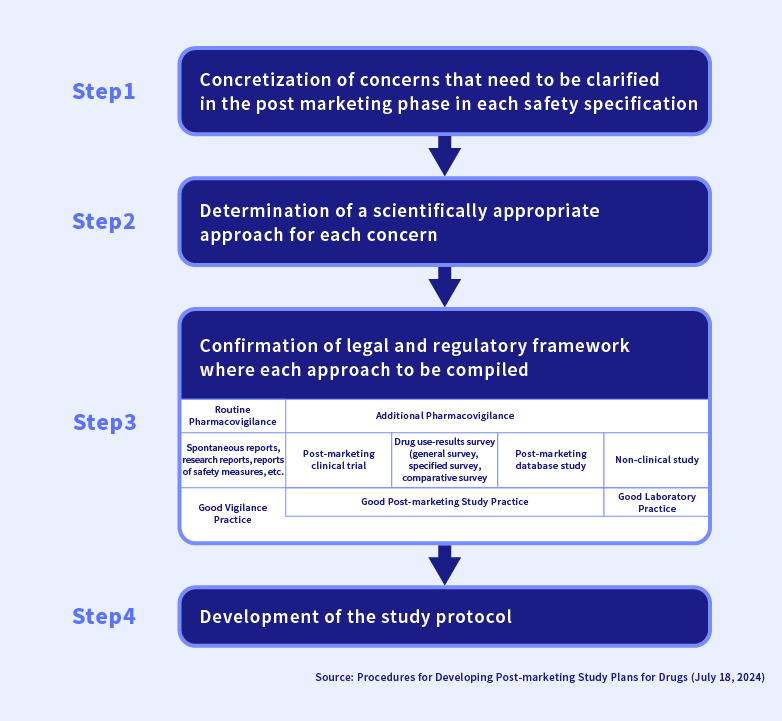
Why was the Decision Tree revised? – Background to the revision and the new framework
In 2017, the GPSP Ordinance was revised to permit the conduct of post-marketing database studies as part of pharmacovigilance activities. In response, the MHLW issued the “Approach to Developing Implementation Plans for Post-Marketing Surveillance of Pharmaceuticals” in 2019, with the aim of allowing scientifically optimal methods to be selected according to the study objective. This notification organized the safety surveillance framework into four steps, centered on the research question (RQ), and presented a systematic process ranging from clarification of safety concerns to regulatory positioning and development of study protocols.
Since then, the drug development environment has changed markedly. The expansion of orphan drug development, precision medicine, and therapies targeting limited patient populations has reduced the feasibility of comprehensively characterizing safety profiles through clinical trials alone. As a result, real-world data (RWD), including medical information databases, have become increasingly important sources of post-marketing safety information. Against this backdrop, the notification was revised on July 18, 2024.
Fundamentally, the revision reframes safety surveillance around scientific justification rather than automatic study conduct. Safety surveillance is evolving beyond formalistic data collection activities toward approaches grounded in scientific rationality.
With respect to the conditions for conducting post-marketing studies, the revised framework clearly emphasizes an RQ-driven approach. Here, RQ refers to a specific and well-defined issue, incorporating elements such as the target population, the drug of interest, the comparator, the efficacy or safety outcome of interest, and the study period. When a concrete RQ can be formulated at the time of approval, implementation should be considered prior to approval. In other cases, reassessment should occur at an appropriate post-marketing time point rather than pre-approval. Appropriate timing may include the point at which early post-marketing surveillance data become available or when new safety information emerges. When no RQ can be established, routine PV, such as adverse event reporting and research or regulatory action reports, remain the primary means of safety information collection. In addition, medical information databases may be used as part of routine pharmacovigilance to assess patient characteristics and real-world patterns of drug use. This specific application will be discussed in more detail in a separate column.
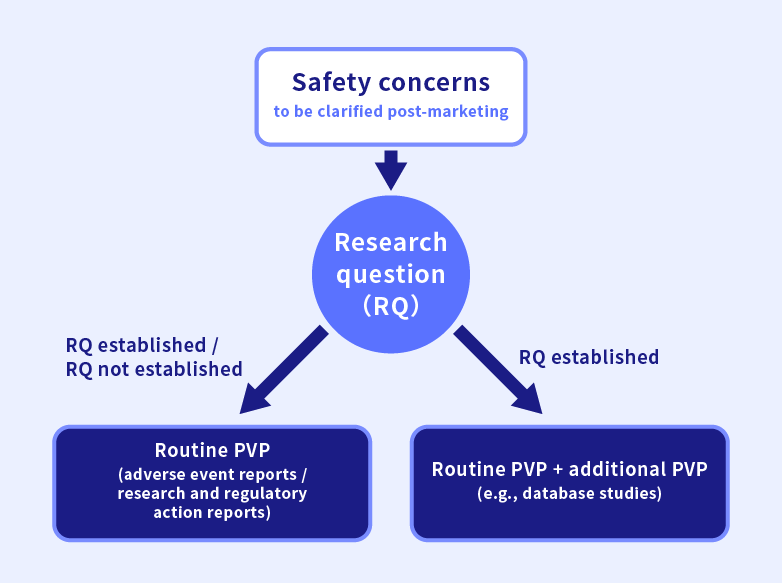
Which safety concerns should be clarified? – A shift in perspective
In risk management plans, safety concerns are classified into three categories: important identified risks, important potential risks, and important missing information. Traditionally, there has been a tendency to conduct broad investigations across all categories. However, this approach has been reconsidered in Step 1 of the revised Decision Tree.
For important identified risks, where a causal relationship between the drug and the adverse event has already been established, the revision indicates that additional investigations should be conducted only under limited conditions. The primary focus should be on risk minimization activities, and the necessity of additional studies should be evaluated more cautiously than in the past. In other words, unless there is a clear scientific rationale, additional pharmacovigilance activities, such as DB studies or post-marketing surveys, are generally not required for important identified risks. Given that many DB studies planned after the GPSP revision focused on important identified risks, it is now possible that even DB studies will not increase in number going forward.
In contrast, important potential risks and important missing information remain safety concerns that warrant investigation under the existing framework. Important potential risks are defined as concerns where a causal relationship between the drug and an adverse event has not yet been established and therefore require clarification. Important missing information refers to situations in which the incidence or characteristics of known adverse reactions may differ in populations expected to use the drug post-marketing, compared with populations previously studied.
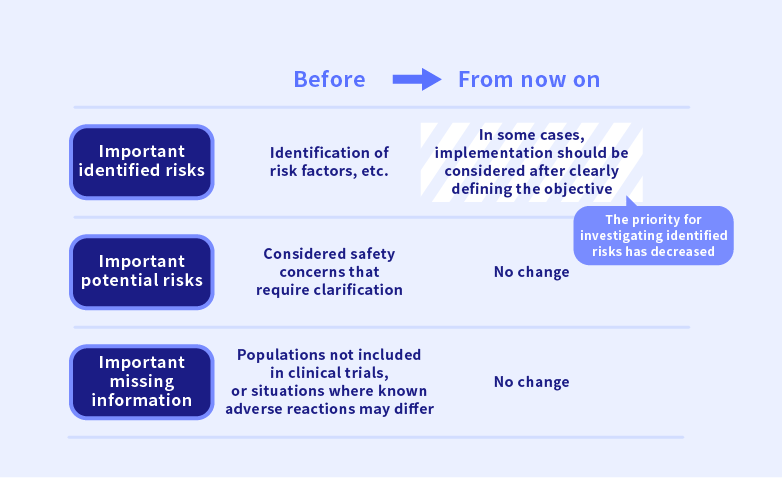
Additional safety surveillance is no longer automatic – Selection based on scientific justification
Even in the initial Decision Tree notification, it was indicated that additional safety monitoring is not mandatory for all products. The most significant change in the current revision is the clarification that additional safety monitoring is required only when it is scientifically justified. This makes the need for such monitoring much more explicit. For example, if safety concerns have not been sufficiently clarified during the approval review or immediately post-marketing surveillance, it is considered appropriate not to conduct additional monitoring and instead collect information through routine pharmacovigilance such as adverse event reports or studies and interventions (routine PV activities). Conversely, additional monitoring is conducted only when a specific research question (RQ) has been defined for a particular safety risk. This change allows unnecessary studies to be avoided and enables limited resources to be focused on risks that genuinely require evaluation.
In Step 2 of the Decision Tree, which concerns the selection of response measures, two points are particularly emphasized:
- The fact that clinical trial case numbers are low or that information is lacking in certain...

For More Information, Please Contact Us Here
About Japanese Healthcare System

What you need to know about the healthcare system in Japan before using the data.
SERVICE
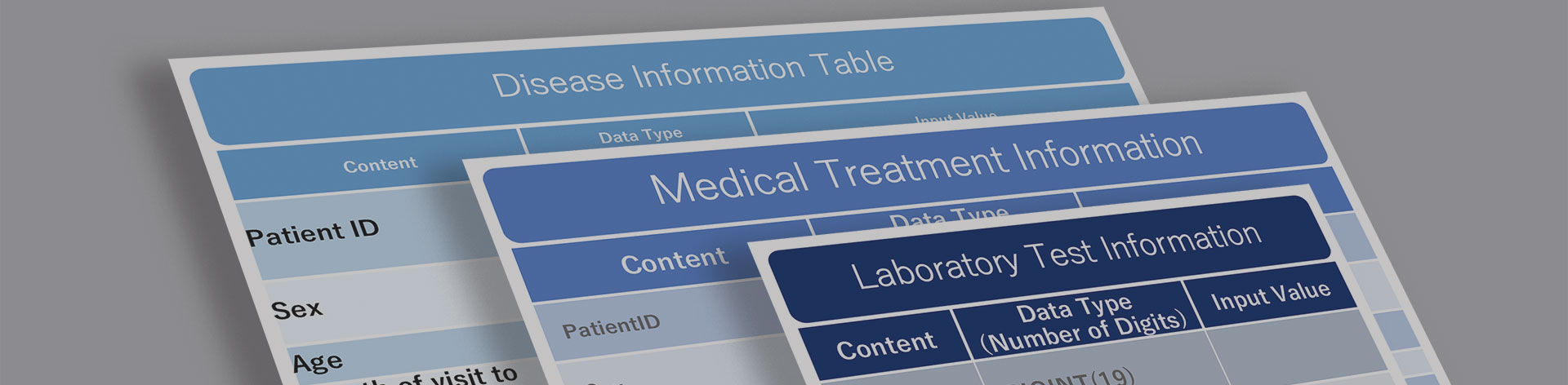
In addition to various web tools that allow you to easily conduct surveys via a browser using our medical database, we offer data provision services categorized into four types to meet your needs and challenges: "Analysis reports" "Datasets," "All Therapeutic Areas Data Provision Service," and "Specific Therapeutic Areas Data Provision Service.


© Medical Data Vision Co., Ltd. All Rights Reserved.