News
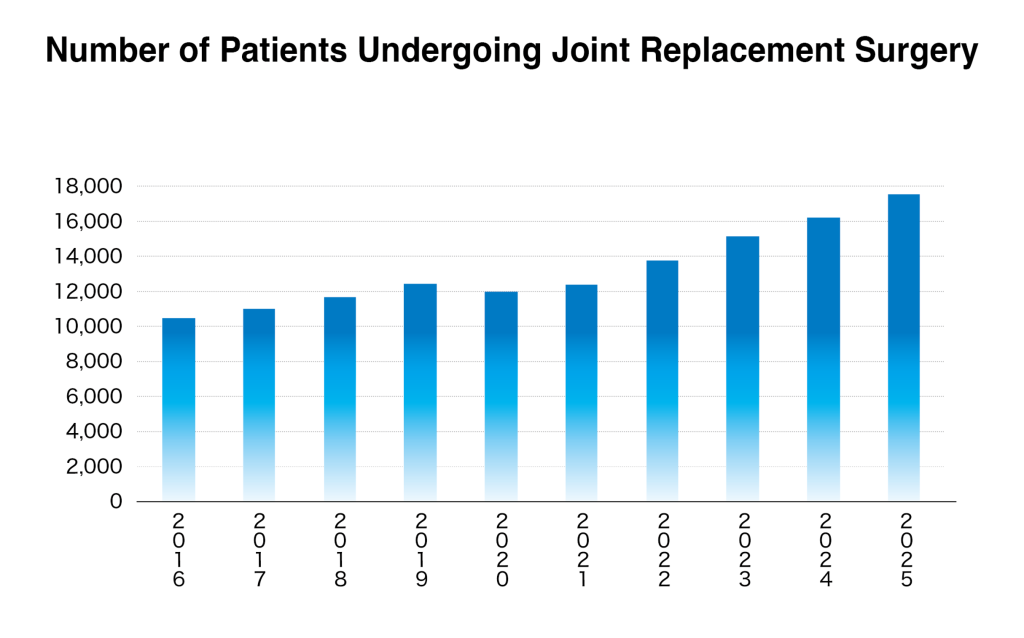
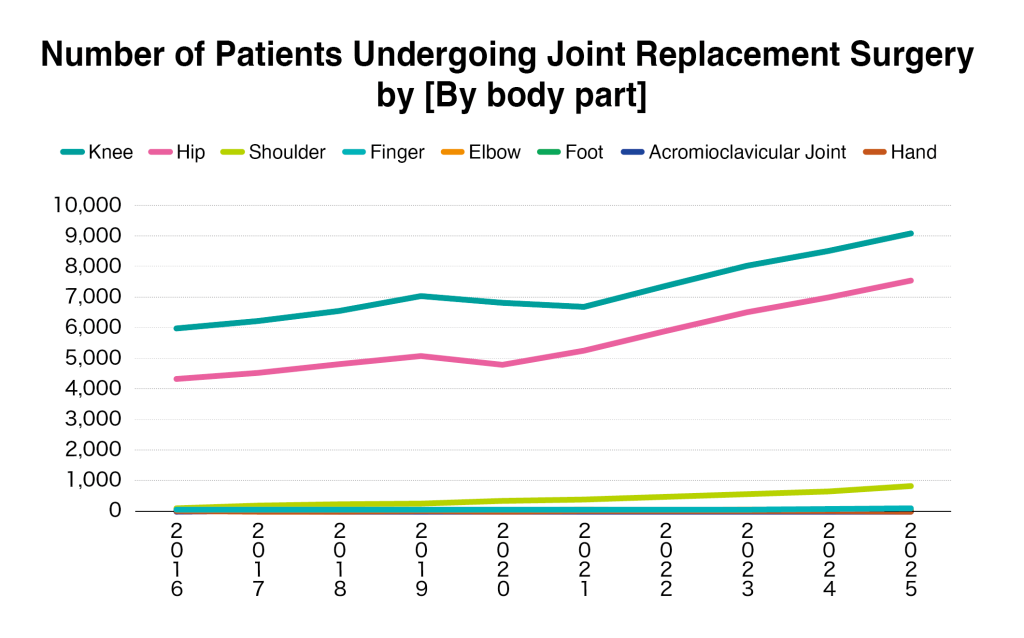
Joint replacement surgeries are increasing year by year, with knee procedures rising 1.5-fold over the past decade, as revealed by Medical big data.
- May 8, 2026
Medical Data Vision Co., Ltd. (hereinafter ‘MDV’) analyzed the number of patients undergoing joint replacement surgeries using one of the largest medical databases in Japan that it maintains. This analysis covered 229 medical institutions for which continuous data were available from January 2016 through December 2025, and summarizes the annual number of patients undergoing joint replacement procedures overall as well as across eight anatomical sites (knee, hip, shoulder, finger, elbow, foot, acromioclavicular joint, and hand). The results show a year-on-year increase in patient numbers.
Total knee arthroplasty is a procedure in which the damaged surface of the knee joint, caused by conditions such as osteoarthritis, is replaced with metal and polyethylene components to relieve pain and improve mobility. The number of patients undergoing this procedure increased approximately 1.5-fold over the past decade, from 5,976 to 9,079.

■ Physician’s Comment
Dr. Masafumi Ito
Department of Orthopedic Surgery
Tokyo Women’s Medical University
The majority of patients indicated for total knee arthroplasty have osteoarthritis of the knee, while other conditions include osteonecrosis of the knee and rheumatoid arthritis. The procedure aims to relieve pain, particularly during walking and stair climbing, thereby improving quality of life (QOL).
The increase in the number of patients is partly attributable to population aging. However, improvements in surgical techniques and prosthetic joint performance have also enabled the procedure to be performed in younger patients. Broadly, there are two surgical approaches: total knee arthroplasty (TKA), in which the entire surface of the knee joint is replaced, and unicompartmental knee arthroplasty (UKA), in which primarily the medial compartment is partially replaced. TKA, which can accommodate a wide range of deformities, accounts for approximately 85% of all cases (based on the 2023 annual report of the Japanese Joint Registry).
The choice between TKA and UKA is made comprehensively based on factors such as the degree of deformity, patient age, and expected postoperative lifestyle. In cases with more severe deformity, TKA is generally indicated; however, for elderly patients with limited physical strength, UKA may be selected in order to reduce surgical burden, even if it may offer less durability. One of the characteristics of TKA is that it corrects leg alignment. Patients who have long suffered from severe varus deformity due to osteoarthritis often appreciate the improvement in appearance.
Regarding postoperative activity restrictions, in my practice I advise patients to avoid high-impact sports involving significant physical contact or heavy loading. However, activities such as golf or light jogging are not restricted. While recommendations may vary depending on individual circumstances, the primary goal of surgery is to relieve pain and enable patients to return to their normal daily lives. For this reason, imposing overly strict activity limitations may, in fact, hinder the achievement of that goal.