



Post-Market Surveillance in Japan: How RWD and RWE Strengthen Drug Safety and Compliance
Japan represents the world’s third-largest pharmaceutical market, valued at approximately USD 86 billion (2025). For global pharmaceutical sponsors, navigating this highly lucrative market requires an advanced understanding of its unique post-approval lifecycle oversight.
Unlike many other global regulatory jurisdictions, Post-Marketing Surveillance (PMS) in Japan is a strict legal requirement, highly formalized, and tightly integrated into the drug re-examination framework. This guide details the structure of Japan’s PMS system, regulator expectations from the PMDA, and how Real-World Data (RWD) can be strategically leveraged to ensure compliance and robust safety monitoring.
Why Japan places strong emphasis on post-market safety
In today’s Japanese healthcare system, these real-world conditions are difficult to fully represent in pre-approval clinical trials, even when those trials are well designed and diverse. As a result, there is an inherent gap between controlled trial environments and actual clinical practice.
Post-market surveillance helps bridge this gap. It plays a critical role in:
- Monitoring safety outcomes over longer time horizons: Many adverse effects only emerge after extended exposure, particularly in chronic therapies.
- Detecting rare or delayed adverse events: Events that are too uncommon to appear in clinical trials may become visible at scale.
- Evaluating benefit–risk in broader patient populations: Real-world use includes patients often excluded from trials, such as the elderly or those with multiple conditions.
- Supporting ongoing regulatory oversight after launch: Regulators maintain active involvement to ensure therapies remain safe and effective in practice.
For global safety teams, Japan’s approach is often more structured than in the US or EU. It is not necessarily more complex, but it is more formalised in how evidence generation and follow-up activities are defined and documented.
How Japan’s PMS system works
Japan’s post-approval framework combines routine pharmacovigilance with structured, product-specific requirements. The exact scope depends on the therapy’s risk profile, clinical context, and regulatory discussions during development.
This layered approach ensures that both general safety monitoring and targeted evidence generation are addressed.
Core post-approval obligations
Most sponsors operating in Japan should expect requirements related to:
- Ongoing safety monitoring and reporting: Continuous collection and evaluation of adverse event data remains foundational.
- Periodic evaluation of benefit–risk in real use: Sponsors must reassess whether the therapy’s benefits continue to outweigh its risks.
- Risk minimisation activities where relevant: This may include educational materials, restricted use conditions, or monitoring programs.
- Post-approval studies or surveillance activities when required: These are often tailored to address specific uncertainties identified at approval.
These obligations are typically defined during regulatory interactions and may evolve over time as new data emerges.
Re-examination and re-evaluation frameworks
Japan is well known for its structured systems for reassessing products after launch. The re-examination period is typically 8 years for standard drugs and up to 10 years for orphan products. During this period, the Marketing Authorization Holder (MAH) must collect data on the drug’s use in real-world clinical settings, including safety and efficacy information. PMDA reviews this accumulated data at the end of the period to re-confirm the drug’s approval status. These frameworks are designed to ensure that early assumptions about safety and effectiveness hold true in broader clinical use.
They are particularly important for:
- Products approved with limited data in certain populations
- Therapies addressing unmet medical needs
- Treatments where long-term outcomes remain uncertain
For global teams, the key takeaway is clear: Japan often expects a well-defined evidence plan that extends beyond approval, especially where real-world uncertainties remain.
Regulatory expectations for PMS activities
Japan’s Pharmaceuticals and Medical Devices Agency (PMDA) expects sponsors to run PMS programs that are proactive, well-documented, and responsive to emerging safety information. Japan’s post-marketing framework operates under two key ordinances: GVP (Good Vigilance Practice), which governs how safety signals are collected and evaluated, and GPSP (Good Post-Marketing Study Practice), which regulates post-marketing database studies (DBS) as an accepted pharmacovigilance measure.
Required safety reporting
Routine pharmacovigilance includes the systematic collection, evaluation, and reporting of adverse events.
Sponsors need robust internal systems for:
- Case intake and processing: Ensuring all safety information is captured accurately and efficiently.
- Medical review and seriousness assessment: Determining clinical relevance and regulatory reporting thresholds.
- Timely reporting and documentation: Meeting strict timelines for submission to authorities.
- Consistent coding and signal tracking: Using standardised terminologies to enable reliable analysis.
Even when global safety systems are in place, Japan-specific workflows are often required to meet local compliance and communication standards.
Post-approval study obligations
Some products require additional post-approval studies or surveillance activities
These may be designed to:
- Confirm safety profiles in broader use
- Evaluate outcomes in specific subgroups
- Monitor long-term exposure risks
- Support ongoing effectiveness evaluation
In these cases, real-world evidence can be useful for designing follow-up programs that are feasible and aligned with routine clinical practice.
Risk management plan requirements
Risk management planning is often central to Japan’s PMS approach.
A strong plan typically outlines:
- Identified and potential risks
- Missing information or uncertainties
- Planned activities to monitor or mitigate risks
- How evidence will be generated and reported
For global teams, early alignment between Japan-specific requirements and global risk management strategies can help avoid duplication and late-stage adjustments.
Key data sources supporting PMS in Japan
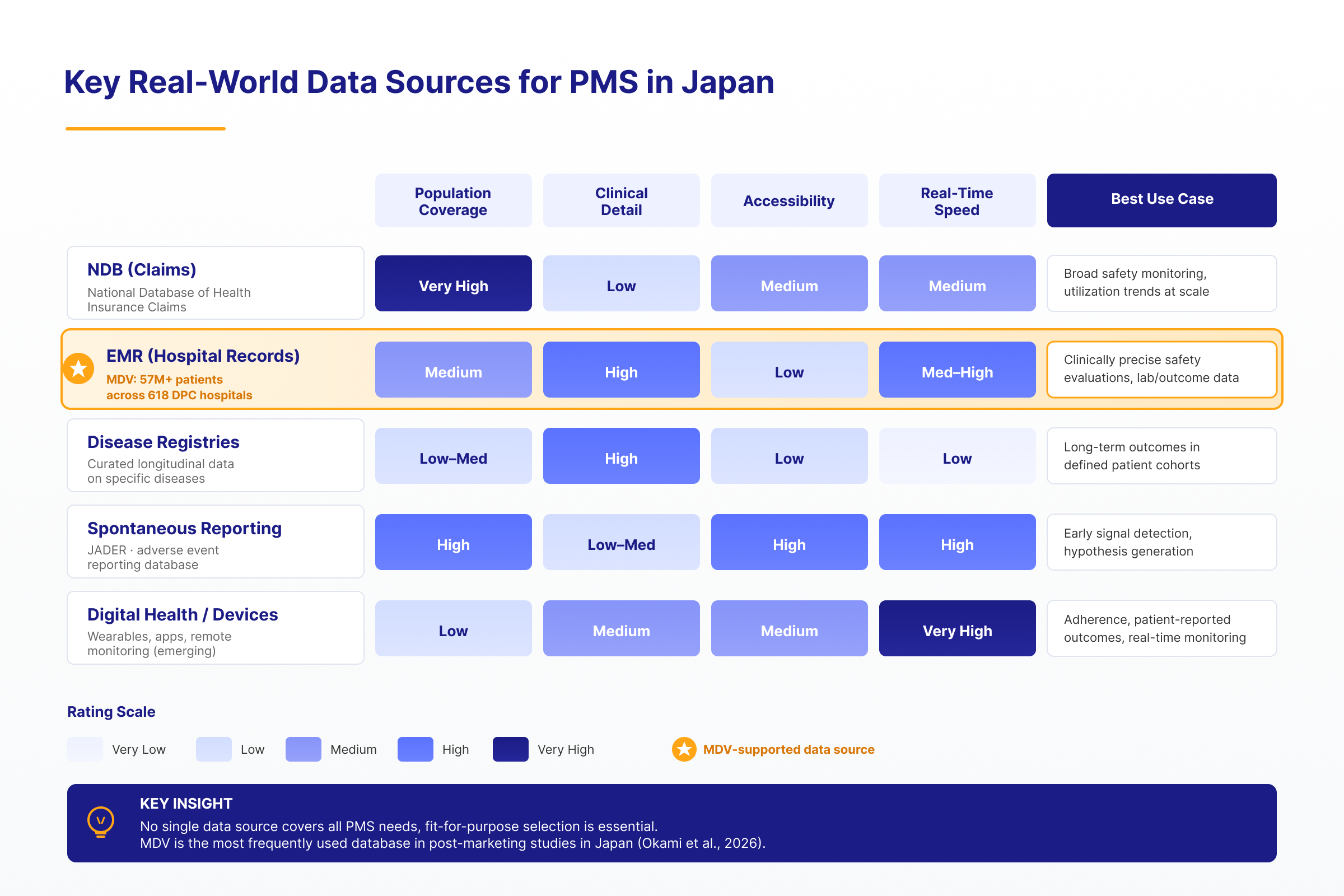
Effective PMS relies on selecting the right data sources for each evidence question. Japan offers a range of real-world datasets, each with distinct strengths and limitations. A recent study published in Clinical and Translational Science (Okami et al., 2026) found that among post-marketing database studies in Japan, Medical Data Vision (MDV) was the most frequently used database
Understanding these differences is essential for building fit-for-purpose evidence strategies.
Claims data (NDB)
Japan’s National Database of Health Insurance Claims and Specific Health Checkups (NDB)
It can be useful for:
- Broad safety monitoring at scale
- Utilisation trends and persistence patterns
- Proxy outcomes related to healthcare encounters
However, clinical detail is limited compared with EMR or registry sources.
Adverse event reporting systems
Spontaneous reporting remains a cornerstone of pharmacovigilance, especially for early signal detection.
These systems can support:
- Initial identification of unexpected safety signals
- Trend monitoring for known risks
- Hypothesis generation for further study
Their limitations—such as underreporting and lack of exposure denominators—mean they are most effective when combined with structured RWD sources.
EMR datasets
Hospital EMR datasets provide richer clinical detail, including lab values, procedures, and physician-recorded outcomes.
They may support:
- More clinically precise safety evaluations
- Subgroup analyses based on patient characteristics
- Improved outcome definitions compared to claims data
Challenges include variability in coding practices and incomplete data capture across different care settings.
Disease registries
Registries can support longitudinal monitoring in defined patient populations, particularly in oncology and rare diseases.
Depending on registry structure, they may help with:
- Long-term outcomes monitoring
- Safety assessment in clinically well-characterised cohorts
- Post-approval evidence generation aligned with practice
Digital health and monitoring devices
Digital health tools are an emerging component of PMS, enabling more continuous and patient-centric data collection.
They may capture:
- Medication adherence and usage patterns
- Patient-reported outcomes and experiences
- Remote monitoring signals
While still evolving, these tools are especially relevant for therapies where real-world behaviour significantly impacts outcomes.
How RWD and RWE strengthen PMS in Japan
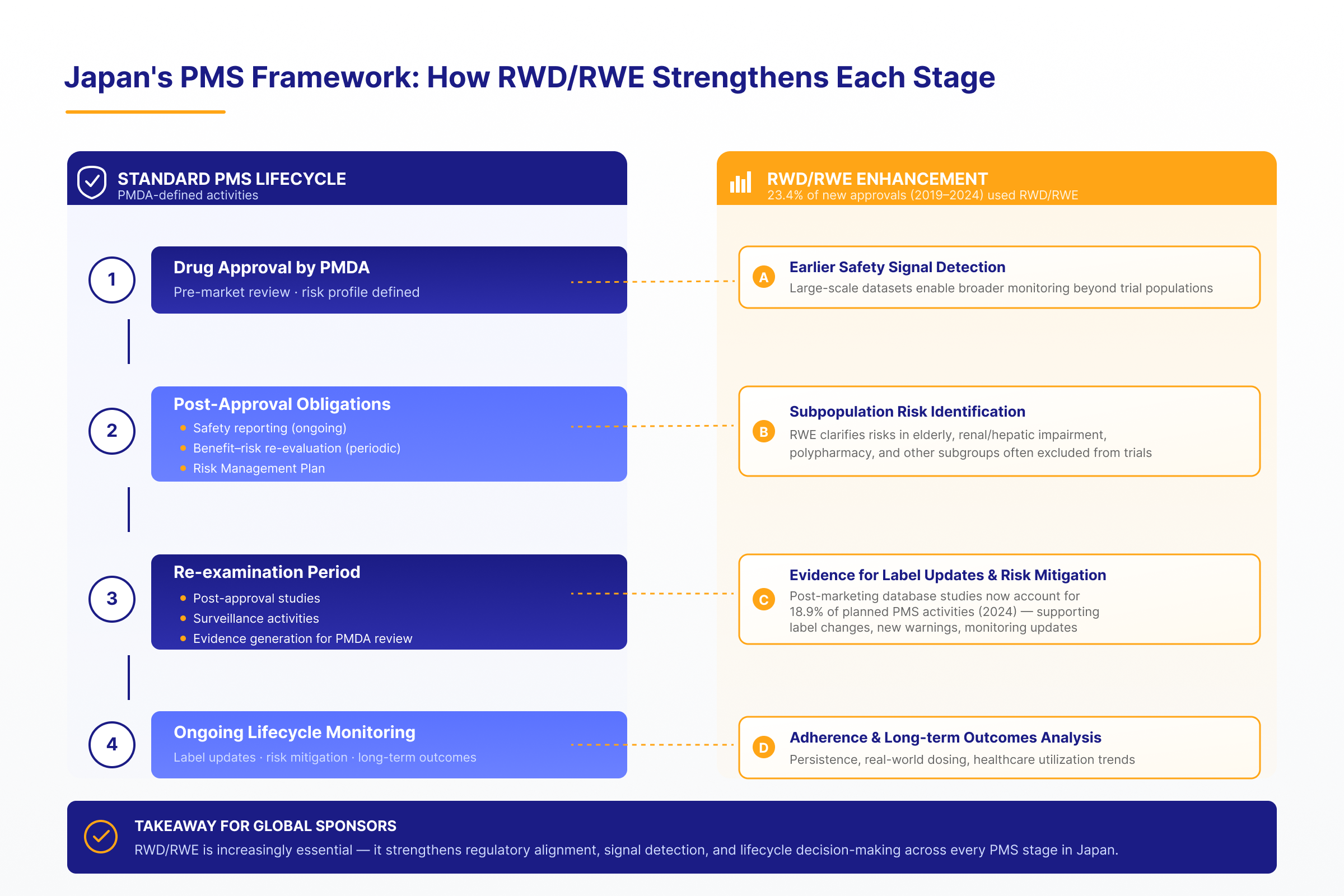
RWD and RWE enhance PMS programs by adding scale, context, and clinical relevance to traditional pharmacovigilance approaches. The trend is clear: among new drugs and regenerative medical products approved in Japan between 2019 and 2024 (N = 674), 23.4% of applications contained RWD/RWE, with usage increasing from 18.1% in 2019 to 30.4% in 2024 (Okami et al., Clinical Pharmacology & Therapeutics, 2025). Post-marketing database studies now account for 18.9% of all planned post-marketing surveillance activities as of 2024.
Their value is maximised when the research question is clearly defined and the dataset is appropriately selected
Earlier safety signal detection
Large-scale datasets enable broader and more continuous monitoring of safety outcomes.
They support:
- Detection of patterns across real-world use
- Identification of trends over time
- Comparisons across regions or care settings
While RWD does not replace spontaneous reporting, it strengthens signal evaluation by providing additional context and population-level insight.
Identifying subpopulation risks
Japan’s patient population often includes elderly individuals and those with complex medical profiles.
RWE studies can help identify differential risks in:
- Elderly patients
- Patients with renal or hepatic impairment
- Patients on multiple concomitant therapies
- Patients with varying disease severity
These insights can inform targeted risk minimisation strategies and more precise clinical guidance.
Supporting label updates and risk mitigation
When new safety insights emerge, RWE can support regulatory decision-making around:
- Label changes
- New warnings or contraindications
- Updated monitoring recommendations
- Enhancements to risk minimisation programs
Submissions are strongest when methods are transparent and study limitations are clearly acknowledged.
Long-term adherence and outcomes analysis
RWD enables evaluation of how therapies are used in practice over time.
This includes:
- Persistence and discontinuation patterns
- Real-world dosing behaviour
- Long-term clinical outcomes (where available)
- Healthcare utilisation trends
Such analyses strengthen ongoing benefit–risk assessments in real-world settings.
Opportunities for global pharma companies
Japan’s PMS environment can support a stronger global safety strategy when approached proactively.
- High-quality longitudinal insight: Long follow-up and structured monitoring can strengthen global safety narratives.
- Stronger alignment with regulators: Clear evidence plans can improve communication and reduce uncertainty.
- Better lifecycle oversight: PMS evidence can support smarter post-approval decision-making across markets.
PMDA’s broader interest in data-driven regulatory science supports this direction.
Challenges in conducting PMS in Japan
Despite strong infrastructure, PMS execution can be constrained by practical issues.
Access restrictions and timelines
Some datasets require complex approval processes and governance steps.
- Early planning is essential
- Data access should be considered during development, not after launch
Data variability and standardization
Differences in coding, completeness, and structure can complicate analysis.
- Harmonisation is often required
- Multi-site studies may require additional validation steps
Communication expectations
Japan’s regulatory environment places strong emphasis on clarity and transparency.
- Documentation must be detailed and structured
- Evidence should be presented in a decision-oriented format
- Proactive engagement is highly valued
Best practices for navigating PMS requirements
Global teams can improve PMS performance in Japan by focusing on execution fundamentals:
- Engage PMDA early to align on post-approval evidence expectations and timelines. Since April 2021, PMDA has operated a dedicated RWD Working Group comprising multidisciplinary experts from new drug review, safety, medical informatics, and epidemiology — early consultation can help clarify how database studies and RWD analyses will be evaluated (see PMDA RWD page: https://www.pmda.go.jp/english/review-services/regulatory-info/0014.html)
- Build integrated safety systems that connect case reporting, signal evaluation, and real-world monitoring
- Leverage local clinical networks to ensure outcomes and coding reflect real practice
- Select datasets fit for purpose, balancing scale, clinical detail, and feasibility
- Document methods clearly, including cohort definitions, follow-up logic, and bias mitigation
Global best-practice frameworks can also support consistency across regions.
Japan’s data-driven future for post-market safety
Post-market surveillance in Japan is evolving toward a more data-driven model, where real-world evidence complements traditional pharmacovigilance and strengthens long-term benefit–risk evaluation. The Japan Pharmaceutical Manufacturers Association (JPMA) published updated guidance
For global sponsors, success depends on:
- Early and proactive planning
- Careful dataset selection
- Clear alignment with regulatory expectations
Teams that treat PMS as an active evidence strategy—rather than a compliance obligation—are better positioned to detect risks early, respond effectively, and maintain trust in the Japanese market.

For More Information, Please Contact Us Here
About Japanese Healthcare System

What you need to know about the healthcare system in Japan before using the data.
SERVICE
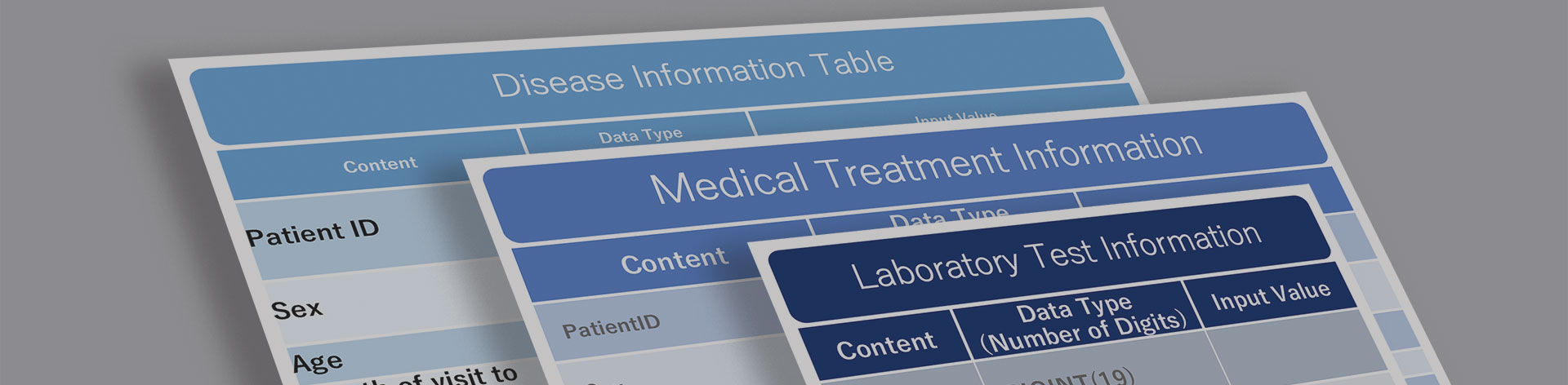
In addition to various web tools that allow you to easily conduct surveys via a browser using our medical database, we offer data provision services categorized into four types to meet your needs and challenges: "Analysis reports" "Datasets," "All Therapeutic Areas Data Provision Service," and "Specific Therapeutic Areas Data Provision Service.


© Medical Data Vision Co., Ltd. All Rights Reserved.