



Real-World Evidence in Japan: How Data-Driven Insights Are Reshaping Drug Development and Regulatory Strategy
Real-world evidence (RWE) is becoming more influential in Japan across the drug development lifecycle, from early clinical planning through post-approval evidence generation. For global pharmaceutical companies, success depends on understanding PMDA expectations, choosing Japanese healthcare datasets that are fit for purpose, and designing observational research that reflects local clinical practice.
A 2025 review of 674 new drugs and regenerative medical products approved in Japan between 2019 and 2024 found that 23.4% of applications contained real-world data or real-world evidence, with the annual share rising from 18.1% in 2019 to 30.4% in 2024. Close to three approved applications in ten now include a real-world component, which places RWE inside routine development planning for global teams.
What has changed is not only the volume of evidence but the level of scrutiny applied to it. Japan’s regulator has built dedicated internal capability and documented its expectations for data reliability, and those expectations vary with how the evidence will be used. This article sets out how RWE is defined and applied in Japan, what the PMDA looks for, which datasets support which questions, and where global teams tend to run into difficulty.
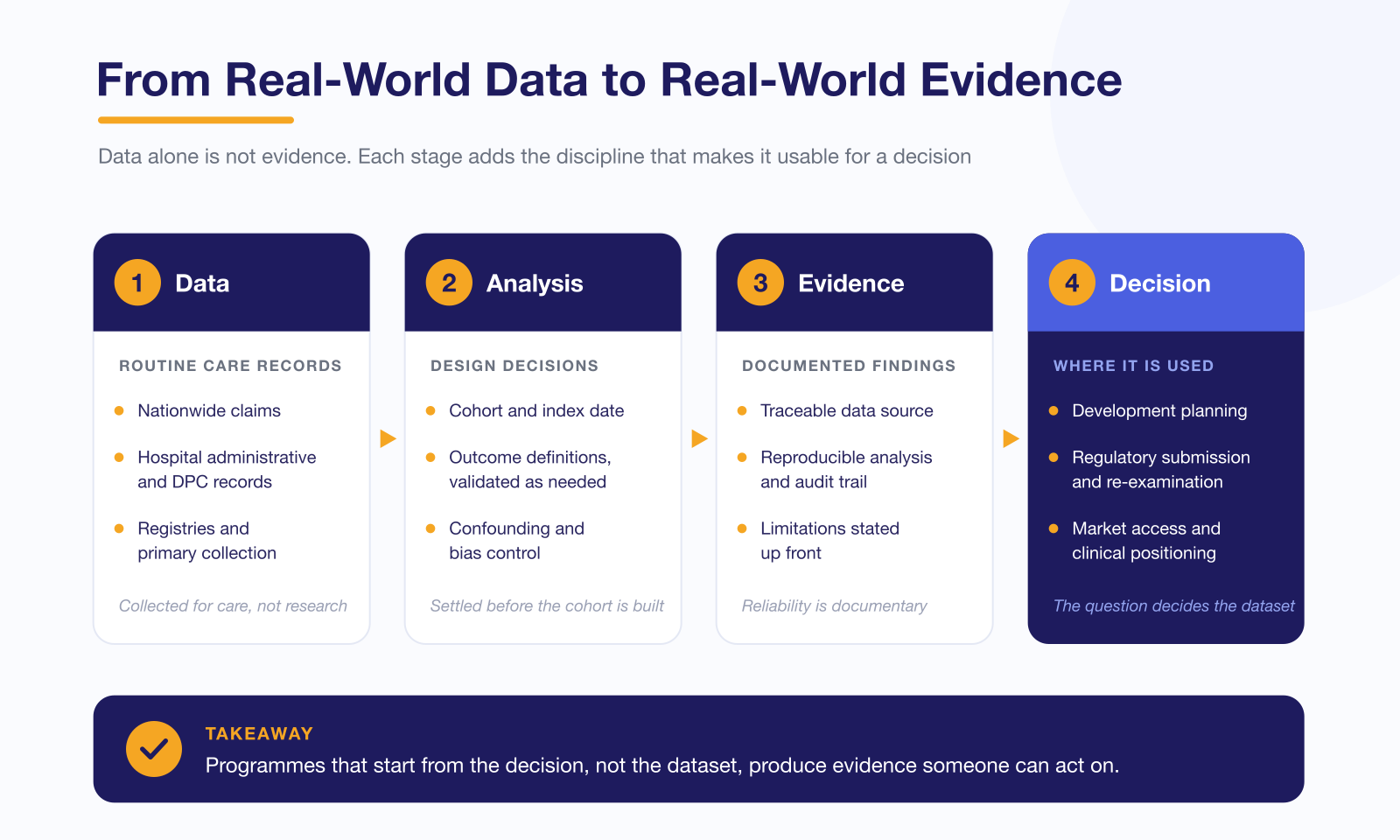
Why RWE matters in Japan today
Japan is the world’s third-largest pharmaceutical market, valued at approximately USD 87 billion in 2025, and its healthcare system provides universal insurance coverage alongside high clinical standards. Claims generated under that system produce nationwide data on most insured care, which gives an unusually consistent picture of how medicines are used in practice. Self-funded treatment, occupational injury schemes, normal childbirth, and many vaccinations fall outside it, so the coverage is broad without being complete.
Demographics sharpen the value of that record. Around 29% of the population is aged 65 or over, so chronic disease, long treatment exposure, and multiple concurrent therapies are the norm rather than the exception. Trial populations rarely reflect this mix, and the gap between trial evidence and routine practice is exactly where real-world evidence earns its place.
The practical questions are also operational. Recruitment in Japan can be constrained, standards of care shift, and protocol assumptions imported from other regions often need local validation. For most global teams the useful question is no longer whether RWE is valuable, but how to generate it in a form that Japanese reviewers and clinicians will accept.
How Japan defines and applies RWE
Real-world evidence refers to clinical evidence about the use, benefits, and risks of a medical product, derived from analysis of real-world data. Japan follows that international definition, but the emphasis in practice is noticeably decision-oriented. Discussions tend to focus less on the concept and more on whether a particular dataset is reliable, traceable, and genuinely suited to the question being asked.
Compared with the US or EU, Japanese stakeholders place greater weight on local relevance. Whether outcomes reflect Japanese prescribing patterns and care pathways matters as much as the statistical design, because treatment sequencing and testing frequency often differ from Western markets. A study designed for another region rarely transfers to Japan without adaptation, even when the scientific question is identical.
Data provenance receives similar attention. Reviewers expect clear documentation of where data originated, what it was originally collected for, and what it cannot show. This is why the need for outcome validation is assessed case by case in Japanese database studies. It matters most where an outcome is identified through a combination of diagnosis, procedure, and treatment codes, since measurement error there feeds directly into the conclusion.
The third difference is positioning. RWE in Japan is most often presented as evidence that complements randomised trials, clarifying natural history, treatment patterns, and outcomes in routine care, although external control arms have contributed to primary evaluation in specific rare disease settings. Studies that set out to substitute for randomised evidence face a considerably higher bar, and framing matters as much as methodology once evidence enters a regulatory conversation.
PMDA’s perspective on RWE
Japan’s Pharmaceuticals and Medical Devices Agency has moved from general interest to specific institutional capability. In April 2021 it established a cross-office RWD Working Group, which operated until September 2024, with a remit covering data reliability standards and methodological approaches. It also operates MID-NET, a database network built with the Ministry of Health, Labour and Welfare across participating healthcare institutions that combines electronic medical record, claims, and DPC data. Sponsors can consult the agency’s real-world data pages for its current position.
Reliability has also been defined in documentary terms. Points to consider for ensuring reliability when registry data supports marketing approval and re-examination applications were issued in March 2021, and a supplementary question and answer document followed in September 2022. Consultation routes covering epidemiological, registry, and database studies have been expanded progressively since 2017, so an evidence plan can be tested before it is committed to.
What PMDA expects methodologically
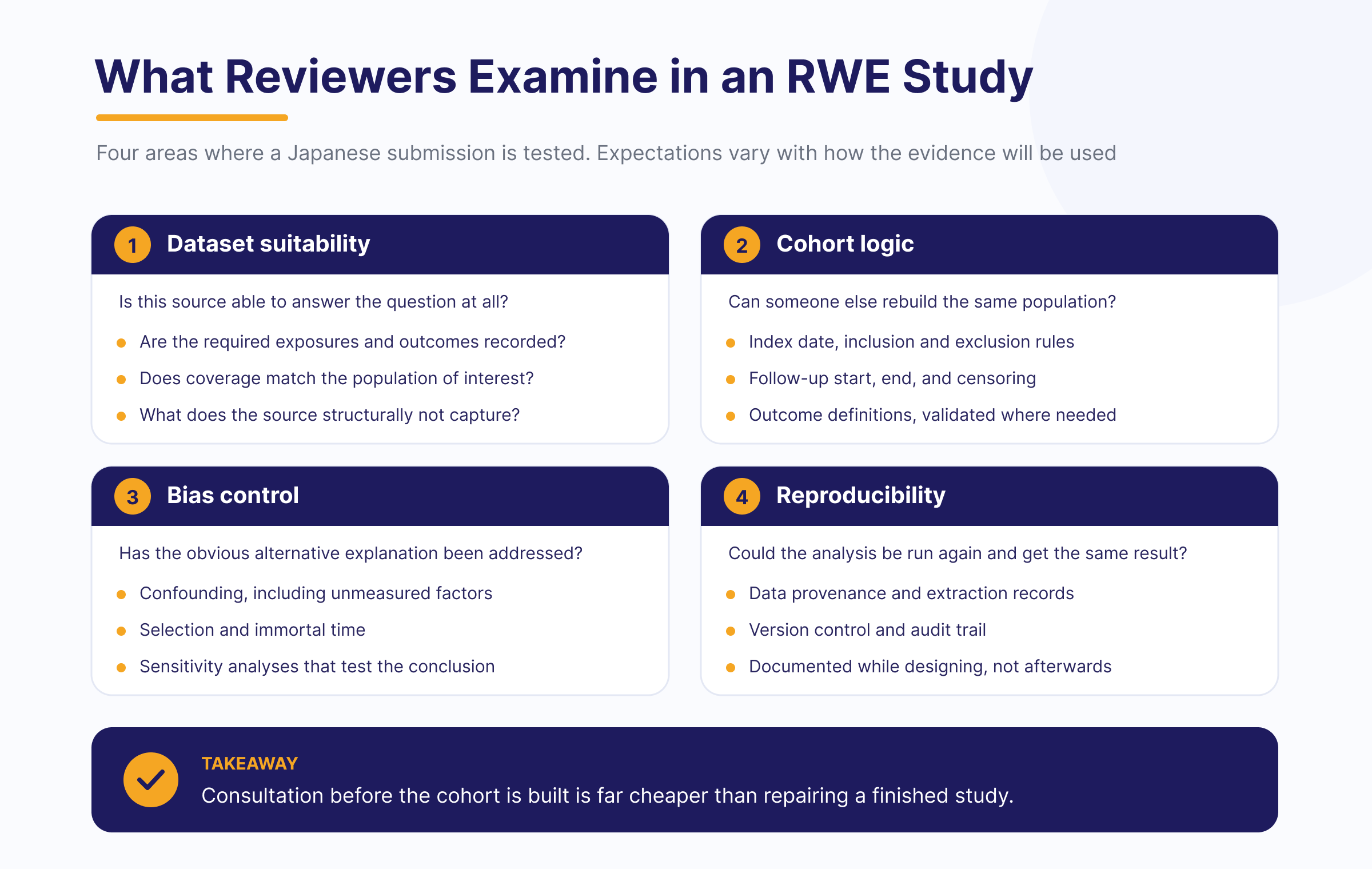
Expectations align with global good practice, and the recurring theme is discipline rather than novelty. Sponsors should be able to explain why the chosen data source can answer the question, how the cohort was constructed and whether that logic can be applied consistently, how confounding and bias were handled, and how another analyst would reproduce the result from the same documentation.
The strength of the claim drives the standard. A descriptive analysis of treatment patterns carries a lighter burden than a comparative effectiveness argument, where unmeasured confounding becomes the central risk. Teams that scale their methodological effort to the claim they intend to make tend to have shorter and more productive regulatory conversations. Principles published by ISPOR provide a useful reference point.
Bringing RWE into consultations early
Timing has a disproportionate effect on how RWE is received. Raised during consultation, an analysis can inform discussion of the intended role of the evidence, acceptable endpoints and definitions, how comparators should be framed in Japanese practice, and which limitations need to be acknowledged from the outset. Introduced late, the same analysis tends to read as justification for decisions already taken, and it carries less weight for that reason alone.
Early consultation can also identify misalignment before the protocol and cohort definitions are finalised. Evidence that is technically sound but misaligned with regulatory expectations is expensive to repair once generated, because the underlying cohort or outcome definition usually has to be rebuilt. Raising the plan early turns that risk into a design question, which is far easier to resolve than a completed study that answers the wrong one.
The data sources behind RWE in Japan
Japan offers several distinct data sources, and each trades scale against clinical depth. Choosing between them is a strategic decision, because the dataset determines which endpoints are available and which confounders can be measured.
Claims data at national scale
The National Database of Health Insurance Claims and Specific Health Checkups holds claims covering most insured care nationwide, supporting prevalence estimates, treatment pathway mapping, resource use analysis, and broad population segmentation. Access is tightly controlled and granted against public interest criteria, so it is not generally available for commercial research. In practice sponsors more often work with commercially accessible claims and hospital databases.
Clinical granularity is the other limitation. Claims were created for reimbursement, so laboratory values, disease severity, and imaging findings are largely absent, and diagnosis codes carry administrative billing logic instead of definitive clinical diagnoses. That constrains endpoint selection and confounding control, and national claims analysis may require linkage or complementary data where greater clinical detail is essential.
Hospital-based databases for clinical granularity
Hospital data sits between national claims and primary collection. Hospital administrative and DPC records describe diagnoses, procedures, and prescribing at the encounter level with more precision than nationwide claims, and hospital information systems can add laboratory values for the institutions and periods where those are captured. For any question that turns on severity or laboratory change over time, that additional detail is what separates a measurable endpoint from an approximation.
Standardisation is the practical obstacle, since coding conventions and completeness vary between institutions. Large hospital databases reduce that friction: MDV’s hospital database holds administrative and DPC data for approximately 60 million patients collected from more than 850 hospitals, and Okami and colleagues reported in Clinical and Translational Science in 2026 that it was the most frequently used data source among the post-marketing database studies they identified. Coverage is hospital-based, so care delivered outside a contributing institution is not visible and a patient seen at more than one hospital may appear more than once.
Registries, digital health, and post-marketing datasets
Registries offer structured longitudinal follow-up within defined cohorts, often with stronger clinical detail than claims sources, and they remain the natural choice for natural history work and long-term outcomes in oncology and rare disease. Governance and access vary considerably between registries, so feasibility deserves an early check rather than an assumption.
Digital health sources such as wearables and remote monitoring platforms are growing, and they capture adherence, symptom patterns, and patient experience that clinical records never see. Validation and linkage remain the constraint for regulatory-grade use. Structured post-marketing surveillance data sits at the other end of the spectrum, and because database studies accounted for 18.9% of planned post-marketing surveillance activities in 2024, post-marketing evidence often becomes the bridge between regulatory obligation and a wider RWE strategy.
How RWE is applied across the drug lifecycle
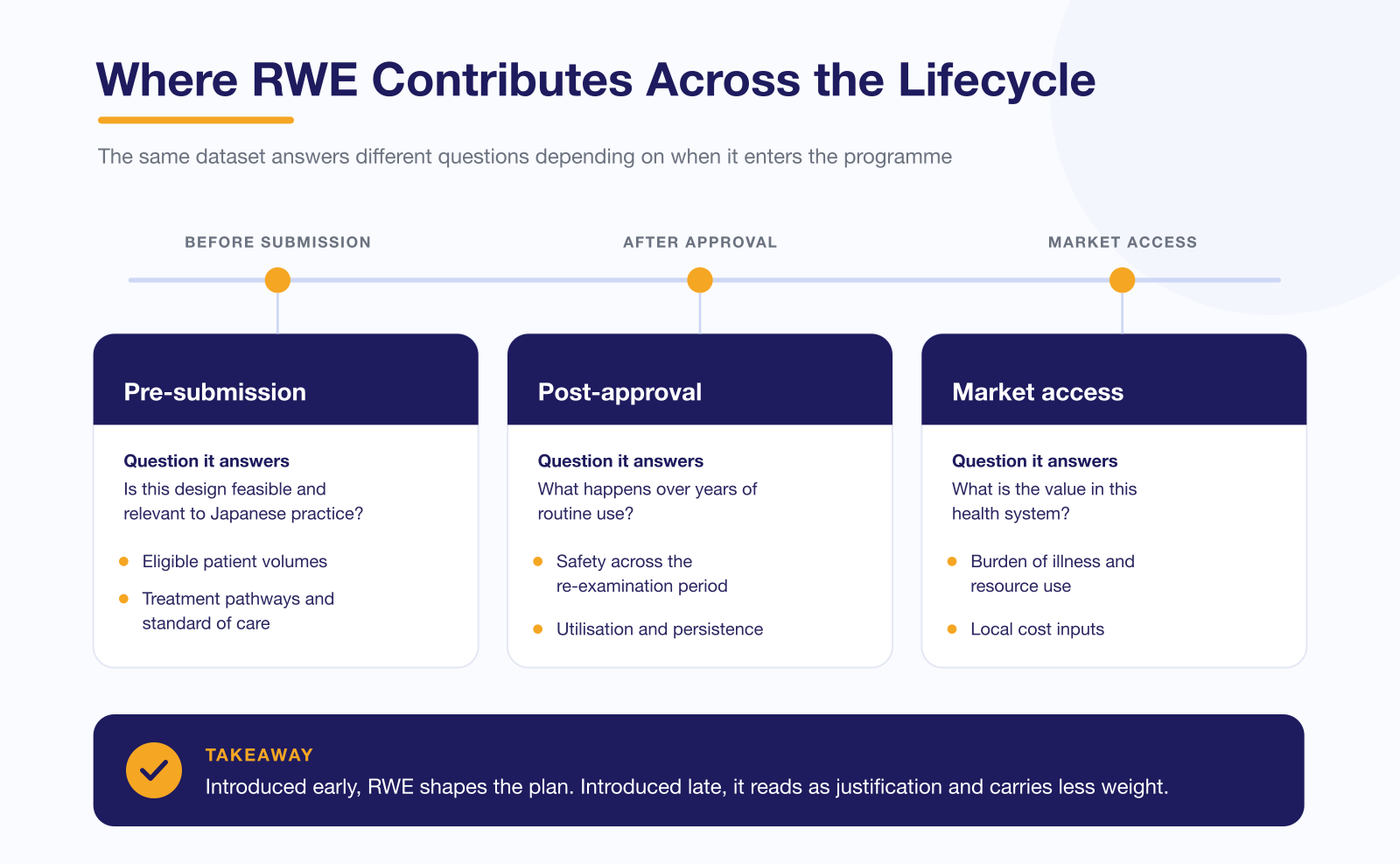
RWE works best when it is tied to a specific lifecycle decision. The same dataset can serve very different purposes depending on the stage, and the design, endpoints, and acceptable level of uncertainty shift with it. Programmes that begin with a dataset and search for a use tend to produce interesting analyses that no one can act on. Those that begin with a decision usually produce something narrower and considerably more useful.
Before submission
Ahead of a filing, RWE is mainly used to reduce planning risk. It can validate feasibility assumptions against Japanese practice, establish baseline event rates and current standard of care, identify subgroups likely to be underrepresented in the trial, and confirm that proposed endpoints are genuinely captured in routine documentation.
There is a second benefit that teams often overlook. Understanding how Japanese clinicians currently treat a condition also indicates how they will read the trial result once the product launches, since a result that looks strong against a Western comparator may land differently where the local standard of care has already moved on. That shapes evidence strategy and launch communication in equal measure.
After approval
Post-approval work is where RWE is most commonly applied in Japan. It supports evidence generation for new indications or populations, real-world effectiveness signals, monitoring of treatment sequencing after launch, and updates to risk management approaches. Long-term safety is a particularly common use, since rare events need larger populations and longer follow-up than a trial can provide.
Dataset choice tends to follow the question. Claims and post-marketing datasets suit surveillance at scale, while EMR and registry sources supply the clinical context needed to interpret a signal. Published case studies are a useful guide to how these sources are combined in practice.
The same datasets support value discussions. For market access and health economics work, RWE clarifies utilisation patterns, treatment persistence, downstream resource use, and how outcomes in routine practice compare with the trial population. Japan’s formal cost-effectiveness evaluation system, introduced in April 2019, has made this evidence directly relevant to price adjustment discussions. The main risk is importing assumptions, because reimbursement structures and care pathways differ enough from the US and EU that cost and utilisation estimates rarely transfer without local adjustment.
Where Japan differs from other markets
Three differences account for most of the friction global sponsors encounter. The first is access. Japan holds strong data assets, but they are more controlled and more fragmented than teams expect, and linkage across claims, EMR, and registry sources is possible in some settings while requiring substantial planning and local partnership in others.
The second is the threshold for acceptance. RWE is used widely, yet expectations stay conservative for high-impact claims, with consistent emphasis on fit-for-purpose justification, transparent methodology, and evidence positioned as supportive. The third is clinical delivery: prescribing behaviour, testing frequency, and referral pathways differ enough that standard of care comparators are not automatically comparable across regions.
What gets in the way
RWE programmes in Japan usually falter on execution, not intent. Fragmentation is the most common problem, because claims provide scale while EMR provides detail, and a study that does not plan for the split ends up with either incomplete outcomes or inadequate confounder adjustment. Deciding which compromise is acceptable is a design question, and it is much easier to settle at the planning stage.
Access and governance affect timelines more than most plans allow. High-value datasets require review and approval steps that need to sit in the schedule from the beginning, particularly where a post-approval commitment has a fixed deadline. Coding variability and inconsistent documentation add a harmonisation step before results can support any high-stakes decision.
Practical recommendations for global teams
Teams that generate credible RWE in Japan tend to concentrate on a small number of fundamentals:
- Engage PMDA early to confirm what role the evidence can play and how it will be interpreted
- Match methodological rigour to the strength of the claim being made
- Select datasets that are fit for purpose, balancing scale, clinical detail, and feasibility of access
- Document cohort definitions, outcome logic, follow-up rules, and sensitivity analyses while the study is being designed
- Work with local partners who understand Japanese clinical practice, coding conventions, and access pathways
None of these practices are unique to Japan. What is specific to Japan is how consistently they are examined, and how early that examination begins, which is why an evidence plan that would pass elsewhere can still require rework here. Treating documentation as part of the study design, not a reporting task at the end, removes most of that gap.
Japan’s increasing reliance on real-world evidence
Real-world evidence has become an established part of drug development in Japan, spanning early planning, regulatory engagement, and post-approval strategy. Close to three in ten applications approved in 2024 included an RWD or RWE component, and the regulator has documented how it expects that evidence to be constructed.
For global sponsors the most productive stance is to treat RWE as decision support. When it is incorporated early and built on Japanese data and methods, it reduces development uncertainty, aligns an evidence plan with local clinical practice, and supports post-approval decisions in the market where the product is sold. Teams that invest in Japan-specific datasets, methods, and regulatory alignment tend to produce evidence that is credible locally and usable in submissions elsewhere.

For More Information, Please Contact Us Here
About Japanese Healthcare System

What you need to know about the healthcare system in Japan before using the data.
SERVICE
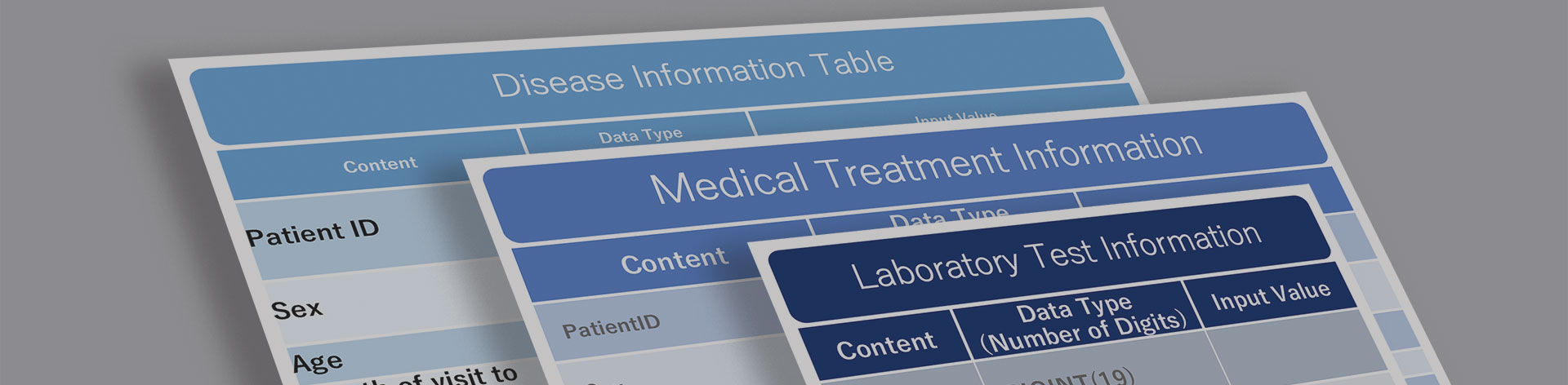
In addition to various web tools that allow you to easily conduct surveys via a browser using our medical database, we offer data provision services categorized into four types to meet your needs and challenges: "Analysis reports" "Datasets," "All Therapeutic Areas Data Provision Service," and "Specific Therapeutic Areas Data Provision Service.


© Medical Data Vision Co., Ltd. All Rights Reserved.